One Man at the Table: Conduct and Accountability at the October 29 Meeting
An account built from the video, the City's records and the rules that govern each person involved.
The Kenyon City Council's October 29 special session was noticed as a meeting about salaries, a tax abatement, fire department appointments and the business park. Thirty-four minutes in, Council Member Kim Helgeson asked the mayor for the floor and read a prepared statement about Randy Eggert, the utility superintendent whose separation after 48 years the council approved on September 21 34:09. She said the public "and his family need to be made aware." She went through an improvement plan, time entries, overtime, leave, personal items in city buildings, a bucket truck, and episodes of insubordination. When she finished, Eggert asked to respond. He was told, "We're not doing any comments at this meeting" 39:54. Later the mayor told him he was "more than welcome" to speak at the next regular meeting 44:40.
Helgeson takes the floor, citing attorney approval and Eggert's Sept 21 words. Whether disclosure was lawful may turn on a final decision, public official status and necessity to an agenda item, and this clip settles none of them.
Mr. Mayor, may I have the floor, please? I have a couple things that I would like to say. First off, what I have to say has been approved by our city attorney, along with Randy previously stating that he had nothing to hide, and he wanted the citizens to know when we held his performance evaluation as an open meeting back on September 21st. It's important information that the public and his family need to be made aware of.
A voice, apparently Eggert's, asks to respond, is refused, and asks when else he could. This is the central moment of the article, though the audio is off-mic and the mayor later invited him to the next meeting.
Eric, can I respond on that? We're not doing any comments at this meeting. So, we're now opening up to special comments. Okay, you can let her talk, but you won't let me. Fine. Thank you. 100%. When else am I supposed to do it? Where is she? You can ask her. Okay. I'm just going to say this. We're going to stay on topic of the meeting. It's a special meeting that we set aside for five
A prepared case was made against one named person, at a meeting with no public comment, and that person was refused an answer. That is the center of this account. The sections below set out what each part of that evening may amount to, and what would establish it.
A possible Open Meeting Law violation
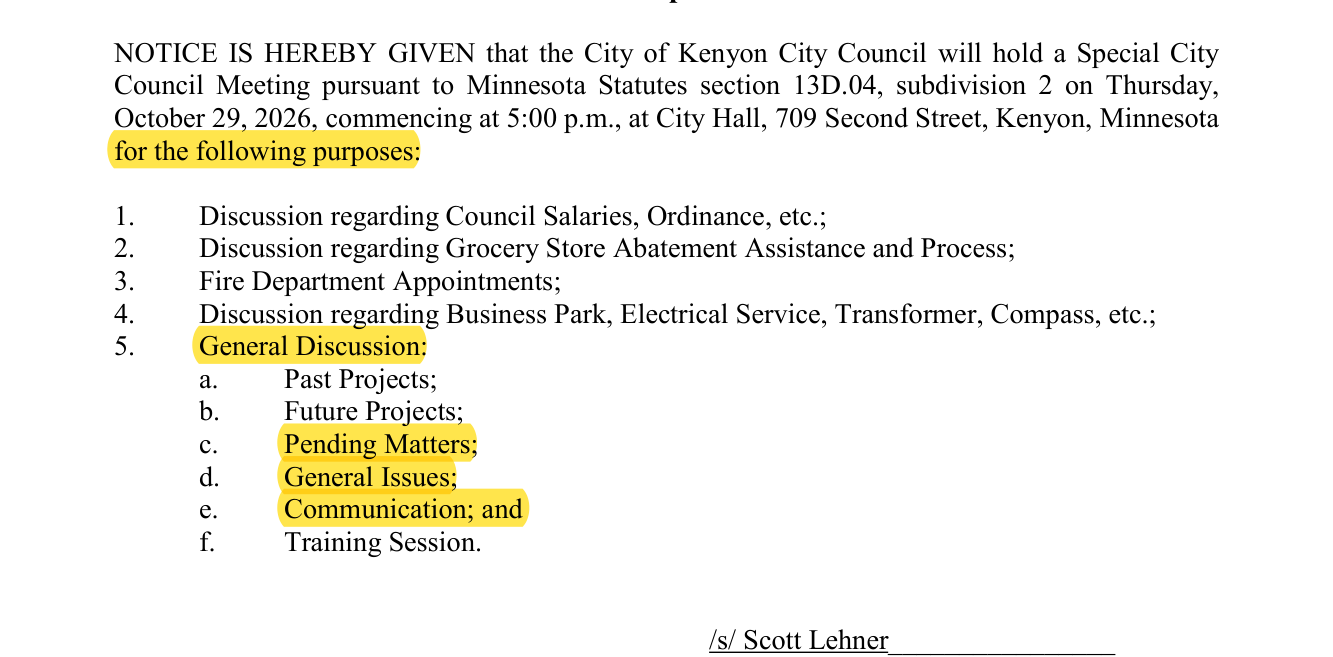
The notice for this meeting was signed by Scott Lehner and dated October 23, 2026. It listed four specific subjects and then "General Discussion: a. Past Projects; b. Future Projects; c. Pending Matters; d. General Issues; e. Communication; and f. Training Session" [47]. Nothing in it mentioned Randy Eggert, a personnel matter, or the reasons for a separation.
The mayor reads the General Discussion list and Helgeson asks for the floor. This places the statement under wording close to the Montrose notice in Opinion 10-020, though Crosslake's sub-issue language gives the City an argument and no opinion tests these words.
All right. Moving on to general discussion board. Any past projects, future, pending, general issues, communication, or training? Mr. Mayor, may I have the floor, please? I have the floor.
What the law requires
Section 13D.04, subd. 2, requires written notice of "the date, time, place, and purpose" of a special meeting, posted at least three days before [1]. The statute does not say in terms that discussion stops there, but the Commissioner of Administration has said so consistently since at least 2004:
- 04-004 (Minnetonka schools): a body's actions are "limited to those topics included in the notice," because otherwise it cannot give notice to people who ask to hear about particular subjects.
- 07-014 (Hampton Township): "Other legal issues may be discussed" did not give notice of a traffic issue, a zoning matter or the planning commission's duties.
- 10-013 (Middle Snake Tamarac): "(but not limited to)" failed.
- 10-020 (Montrose City Council): "Financial Review / Training / Any Other Business that May Arise" was "not sufficient." If the council "was planning to discuss other business at the meeting, it needed to specifically identify the topic(s)."
- 19-006 (Rockville): "the public body must limit the discussion to that purpose."
- 22-009 (Modern Montessori): "purpose" means the intended object of the meeting, and a notice of closed consideration did not cover an open vote to end employment.
- 23-003 (Crosslake City Council): the rule reaches discussion, with no vote needed. A broad topic may reach sub-issues, but issues outside it violate the law.
The League of Minnesota Cities gives its members the same instruction: "council members should only address the specific issue or issues that the notice lists" [2]. A Court of Appeals panel has written, in an unpublished decision, that "the prohibition to act beyond the notice is necessarily implied in the notice requirement (or the notice requirement is meaningless)" [48].
What "Pending Matters" meant
The City's best argument would be that "Pending Matters" or "General Issues" covered the statement. Later in the same item, a speaker who appears to be Riggs explained why the item was on the agenda: "that was on there because you've had some data practices requests and questions about some of your pending matters." He then named them: "One was obviously the business park... The other was obviously coming up with the grocery store and the abatement there. The third one was the Kenyon Crossings," adding "that's why Scott had put this on here" 44:58. All three are development projects. Eggert's separation was not among them. If the agenda's author meant those three matters, the statement may have been outside the notice on the City's own account. The City may answer that Helgeson spoke under General Discussion, which the mayor had just opened 33:54, and that Lehner himself used "pending matters" for the KMU superintendent posting 50:38. A posting to fill a job and the reasons for a settled departure may still be different subjects.
Apparently Riggs describes Pending Matters as three development projects tied to data requests. If the author meant those, the statement may have fallen outside the notice, though Helgeson spoke under General Discussion, which had other sub-headings.
Well, that was on there because you've had some data practices requests and questions about some of your pending matters. One was obviously the business part that you've talked about in some capacity. The other was obviously coming up with the grocery store and the abatement there. The third one was the Kenyon crossings, which you've approved to tax increment district for. That's gone through a process of over, I don't know, two, two and a half, three years of getting to where it is right now. So I can certainly update you with that, but that's why Scott had put this on. We've had questions if you want updates, I certainly will try to. Scott can, other staff can. I don't know if that's necessary or not.
The mayor holds the room to the topics after the statement has been read, and the machine transcript says "minutes" here. The limit may have been applied unevenly, though he may have regarded her statement as within General Discussion.
I'm just going to say this. We're going to stay on topic of the meeting. It's a special meeting that we set aside for five topics.
The City may argue the separation remained pending until its December 9 effective date. Its terms, though, were resolved on September 21 [12][26]. "General Issues" is the kind of catch-all that 07-014 and 10-020 reject, and it may give the public no more notice than "Any Other Business." A resident deciding whether to attend could not have learned from this notice that a departing superintendent's record would be read out.
Lehner uses "pending matters" for job postings. This favors the City's reading that the phrase reached personnel subjects, but a posting to fill a job and the reasons for a closed departure may be different things.
yeah um scott yeah just just under pending matters just a couple things to bring a council up to speed on uh we did uh put the public works posting up to replace the vacancy we have at public works that went up on monday and the same time we put up a uh superintendent uh operations manager for kmu that was uh posted on monday also
Kenyon knows how to give this notice
The City has shown that it can name a personnel matter when it intends to discuss one. Its January 28, 2026 notice identified "preliminary consideration of allegations against an employee" and named him. Its June 30, 2025 notice named Mr. Wayne Ehrich, and its December 9, 2025 notice stated it would discuss internal affairs data on law enforcement misconduct. Its August 31, 2026 notice named "Mr. Randy Eggert," and cited the statutes for allegations and performance [49]. Its attorney's firm drafted those notices. Against that history, omitting him here may have been a choice. Whether anyone knew on October 23 that this statement was coming is unknown, and Helgeson and Lehner both sit on the committee involved. If it was planned after the notice went out, the council had three days' notice to give and could have called another meeting.
Sept 21 may raise two further questions
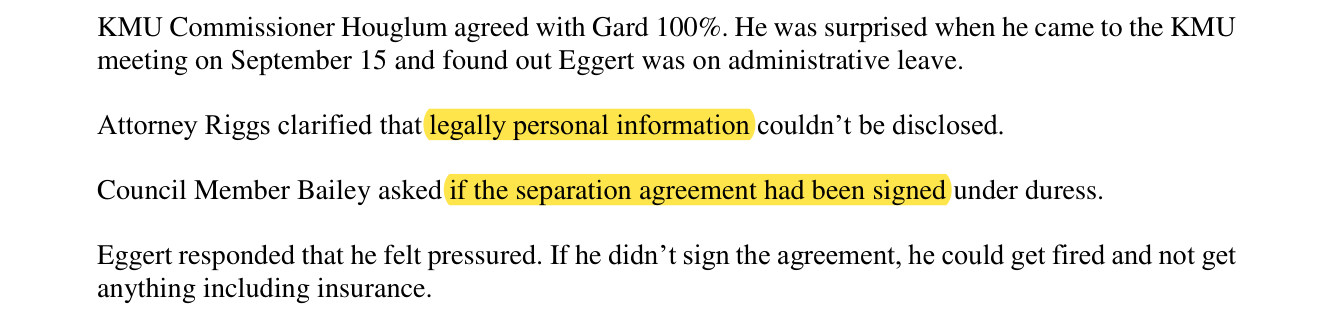
Helgeson opened by saying Eggert "wanted the citizens to know when we held his performance evaluation as an open meeting back on September 21st" 34:09. The minutes do not describe that. Under "Evaluate the Performance of an Individual... Mr. Randy Eggert" they say "No discussion," and again under the follow-up. What they record is that "Administrator Lehner handed out a packet addressing Mr. Eggert's performance and evaluation," and that Gard could not fairly vote on it [12]. The public evaluation she relied on may not have taken place in any meaningful sense. Section 13D.05, subd. 3(a), also requires a body that closes a meeting to evaluate someone to "summarize its conclusions" at its next open meeting. Those minutes do not make clear whether the room closed, the October 13 minutes are not published, and the captions of that meeting show no such summary.
Helgeson takes the floor, citing attorney approval and Eggert's Sept 21 words. Whether disclosure was lawful may turn on a final decision, public official status and necessity to an agenda item, and this clip settles none of them.
Mr. Mayor, may I have the floor, please? I have a couple things that I would like to say. First off, what I have to say has been approved by our city attorney, along with Randy previously stating that he had nothing to hide, and he wanted the citizens to know when we held his performance evaluation as an open meeting back on September 21st. It's important information that the public and his family need to be made aware of.
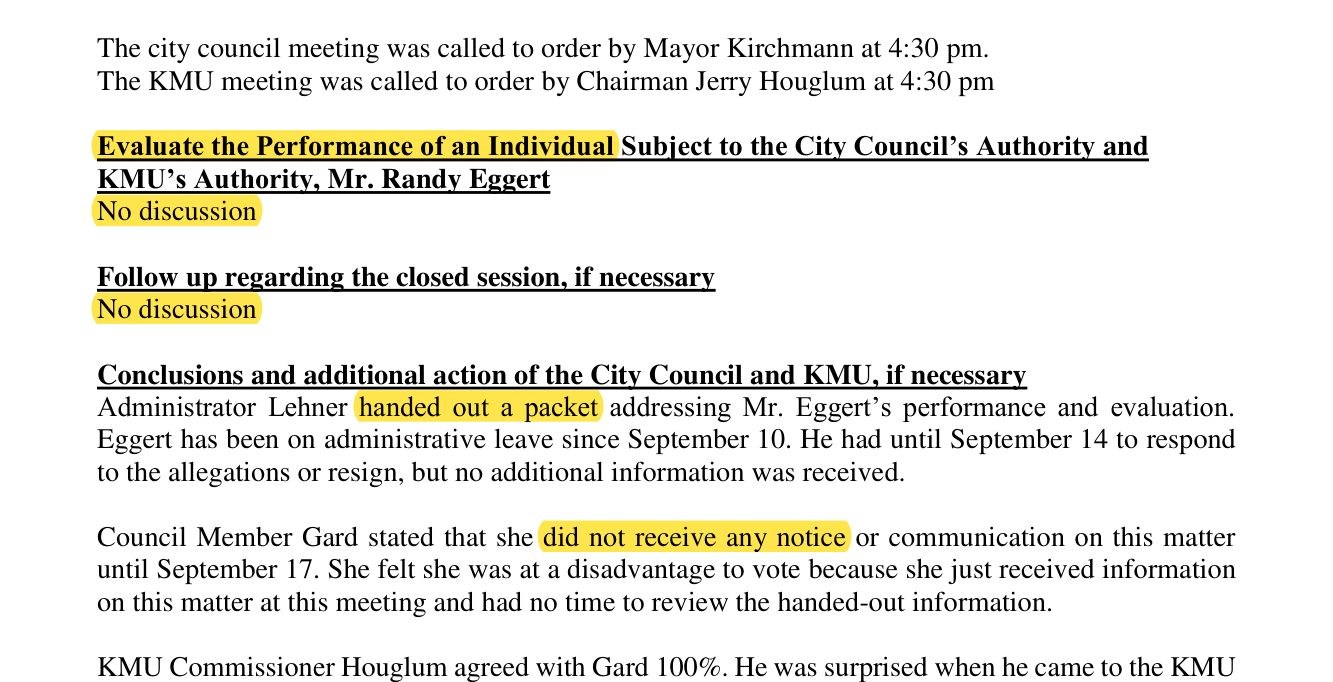
The packet presents a dilemma. Section 13D.01, subd. 6, requires a copy of printed materials distributed to members at an open meeting to be available for public inspection, unless they are classified as not public [50]. If the packet was public, residents in that room were entitled to see it. If it was not public, the question becomes how the same content could be read aloud five weeks later. The City may be able to answer one way or the other. It may struggle to answer both ways.
Who called the meeting?
Section 412.191, subd. 2, says special meetings "may be called by the mayor or by any two members of a five-member council by writing filed with the clerk" [50]. The notice is signed by the administrator. The notice alone does not show who called it, or whether a written call exists. The answer may be simple, and it should be in the file.
Riggs says he asked that the abatement update be put on the agenda. This shows counsel shaping the agenda, but it says nothing about who called the meeting under § 412.191; a written call in the file would answer that.
Again, I ask that this be put on if you're going to have a meeting like this to have a quick just update of where this is at, what's happened. Typically,
The City's own code
Section 200.17 says "proper decorum must be maintained by the mayor" [7]. A long personnel statement proceeded without interruption, and only afterward were others held to the topics. Eggert was refused a reply, and Lehner's remarks were followed by a move to adjourn 53:24. Section 200.19 says matters "inappropriate for consideration at a meeting may not be considered" without unanimous consent, and § 305.01 says the council "will confine its activities to determining matters of policy" [7]. A member trying an employment dispute from the dais may have run against both, and no consent was sought.
Lehner finishes after "Continue, please," and a voice, apparently the mayor's, says he is ready to adjourn. He had the floor while Eggert did not, but whether that was uneven treatment depends on who controlled the floor, and the audio is unclear.
I'm trying to do my job and I was asked to do it to the best of life. Continue, please. Now I'm being attacked personally and publicly because I was trying to move the city of Kenyon ahead. I don't claim to be perfect, but I am trying to do the best I can. Because this meeting was supposed to discuss the special meetings. We've already gone through everything on the agenda. I am ready to adjourn the meeting. If there's any comments that we've made about what's happening in town revolving gossip or anything else, we will discuss it at that time. This was a special meeting to cover a few topics. So if there's nothing else to be said...
What could be done
Any resident who disagrees with how members performed their duties may ask the Commissioner for an opinion under § 13.072. There is no fee, the Commissioner must decline within five business days or issue an opinion within 50 days, and the request must be signed and timely [1]. An adverse opinion would not void anything said, but courts must defer to it, and a court "shall award" fees if a body later ignores it. Section 13D.06 allows any person to sue for a civil penalty of up to $300 for an intentional violation, personally against the member, with fees up to $13,000. Elseth requires intent to violate the chapter, and "advisory opinions are persuasive only" [48]. Here the statement that a lawyer approved the text may cut both ways: it may suggest good faith, or it may show that someone knew to ask.
Helgeson said the city attorney approved the text. Elseth requires intent to violate the chapter, and this line may cut either way, suggesting good faith or that someone knew to ask; it rests on her word alone.
First off, what I have to say has been approved by our city attorney, along with Randy previously stating that he had nothing to hide.
Why it was said at all
The City had a settled matter, a signed agreement, and no legal need to revisit it. The record suggests a reason it did. The statement may have been written to answer a specific public case against the administrator, which had been building for two weeks.
A resident at Oct 13 comment says Lehner drove off city workers and outsourced work. It is one resident's opinion, not evidence of either claim, but it shows public criticism of him had been voiced two weeks before the statement.
In the last five years, we've had people retire, people come, people go. We have even let people go or have had to resign so they're not fired. I think out of our four most recent terminations, the administration and the council has got it wrong three out of the four cases. Scott has ran off our city workers that are also lifelong residents. He's talked you all into races for himself. As he has outsourced much of the work that our city administrators have done and required to handle in the past.
| Date | Event |
|---|---|
| Sept 21 | Separation approved; packet handed out; no reasons in the resolution |
| Oct 13 | Lehner's account to the council |
| Oct 20 | Eggert disputes it at KMU, with Helgeson present |
| Oct 21 | Kenyon Leader carries the account |
| Oct 22 | Gard says Lehner called and invited her to a meeting |
| Oct 23 | Gard says she was reprimanded over the Oct 21 Leader article, with Helgeson by video and the city attorney expected; she resigns |
| Oct 23 | Notice signed, with "Communication" listed |
| Oct 26 | City's records produced; a records request seeks the Sept 21 packet |
| Oct 27 | Debbie Eggert's letter in the Leader |
| Oct 29, 5 p.m. | Helgeson's statement |
The statement may answer the letter point by point
Debbie Eggert's letter ran two days before the meeting [27]. Set side by side, the statement tracks its claims closely, and Helgeson said the information was something "his family need to be made aware of" 34:09.
Helgeson said Eggert was not told to sign or be fired. If the report's reading holds, this answers Debbie Eggert's letter directly, but the match is an inference, and who wrote the text and when would establish it.
Randy was not told he had to sign the separation agreement or he would be terminated. He was presented with the agreement and it was explained that if he chose to not sign it, the next action was that it would go to the entire council who would then hear the personnel committee's reasons for recommending releasing him from his duties and would then vote on it. If council majority were yes, then he would be let go immediately and his benefits would immediately end. on paid leave until his scheduled surgery and his benefits continued through December.
Helgeson said his kids had asked what happened, and blamed one man's refusal to accept change. The family reference may tie the statement to Debbie Eggert's letter, and the blame is her allegation, not a finding.
His kids have asked what happened in the last two years, causing him to no longer like his job or not sleep well. Well, this would be the reason. One man's refusal to accept changes in the workplace.
| The letter said | The statement replied |
|---|---|
| Hostile workplace began about two years ago, with Lehner | "Drama" two years ago "due to three employees" |
| Forced to sign under duress or lose insurance | "Randy was not told he had to sign" |
| Before scheduled knee surgery | Paid leave offered "until his scheduled surgery," benefits through December |
| He sought help and was told to get along | "One man's refusal to accept changes" |
| Lehner asked for authority over KMU | Agreements "approved many years ago"; hired for "the merger" |
| Lehner claims ignorance; minutes show he knew | Delay "is not the reason"; "we just found out" |
| She acknowledges he made mistakes | Nine areas he "admitted twice" |
If the statement was a reply to a family's public letter, then the City used a special council meeting, with no comment period, to answer a private citizen's letter to the editor about her husband. "Communication" on an October 23 notice may mean the plan predated the letter, or may mean something else entirely. Who wrote the text, and when, would show which.
Helgeson said drama began two years ago with three employees and that departments now work together. This is her account, and it suggests she saw the matter as longstanding; it proves neither the cause nor the present harmony.
Trust me when I say many hours have been spent working through personnel issues between all the in-person meetings and phone calls due to the drama that started this time two years ago due to three employees and has been continually a problem until just this month. Now you can see both departments working on jobs together and running things like they should have always been, a City of Kenyon team. Looking back now, maybe the previous mayor and our interim administrator at that time let all three go at that time, but I had not agreed.
The three people on the committee
The City's Personnel Committee consists of Don Kirchmann, Kim Helgeson and Scott Lehner [49]. Eggert's family's complaint is about Lehner, and a family member has written that when Eggert raised concerns about Scott he was told to get along [23]. If so, the person he had a grievance against sat on the committee that handled his performance. The same three then took the public roles on October 29: Helgeson spoke, Kirchmann presided and ruled on who else could, and Lehner sat beside them. Kirchmann also moved the council's separation resolution, and seconded and voted for KMU's, which passed 2-1 with Houglum opposed [12]. KMU's liaison to that committee, Doug Henke, said he was not included, although he moved the KMU resolution. A process run by the people closest to a dispute may not look fair however careful they were.
Deanna Gard's account adds to this. In a post to the Concerned Citizens of Kenyon group, she writes that Lehner called her on October 22 and invited her to a "teams meeting" on October 23, that she was then told the city attorney would be coming and Helgeson would join by video, and that she was reprimanded for what she told the Kenyon Leader and told "the council needs to be united in what we say." She writes that she learned afterward the mayor and other members had not been told, that Helgeson "was not in a position to reprimand me," and that she resigned that day. The Oct 29 notice carries the same date. Any notes, calendar entries or Teams records would establish it, and whether a member can be disciplined at all outside a council vote would be a question for independent counsel.
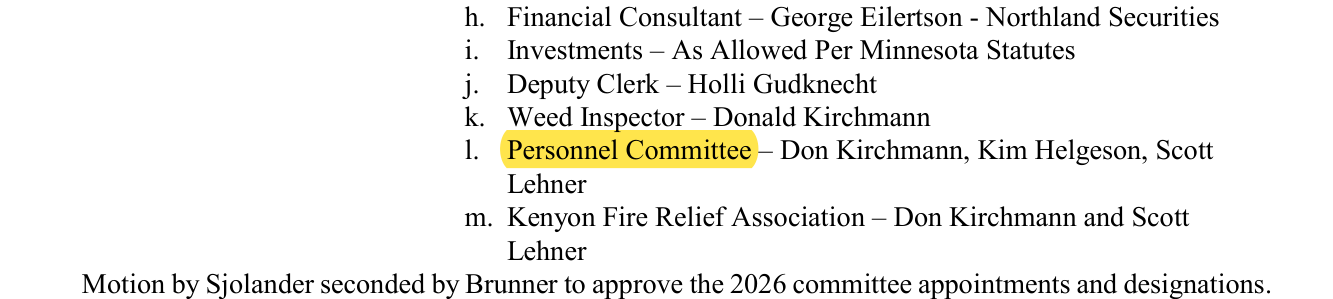
The mayor reads the 2026 Personnel Committee: Kirchmann, Helgeson and Lehner. The three who took public roles on Oct 29 were formally appointed in an ordinary way, and the concern is only how a dispute involving one of them was handled.
Personnel Committee, Don Kirchmann, Kim Helgeson, Scott Lehner. Kenyon Fire Relief Associations, Don Kirchmann and Scott Lehner. Part-time police recommendation. Are we enhancing on that? Oh, I'm sorry. I need a motion to accept all the appointments. I'll make that. I'll second. All in favor? Aye. Motion passes.
Apparently Lehner answers whether he wants to be Eggert's boss by saying responsibility stops with him. He thus had a stake in the reporting dispute, though seeking clear authority is not itself bias, and he says the council gave him the task.
So you just want to be your boss. That's a different way of putting it. For the simple fact that it doesn't feed my ego, if that's what you're thinking. I don't have to be the boss. But at the end of the day, the buck's got to stop with somebody. And the council has tasked me that the buck stops with me. And that doesn't just mean KMU. That means everything that goes on in the city. So if they want me to manage the city the way I've been asked to do that, that means I have to have the ability and the authority to be able to manage that. I don't necessarily agree that I have to be the boss. It's not what I came here to do. I came here to do a job that I was asked to do. And if that means that KMU has to come in line with the rest of the entities, yeah, I guess so. I guess the answer is yes. But that's
Boyles asks the council to charge the personnel committee with bringing KMU under the City. The committee's role therefore began as a proposed council directive, which favors its legitimacy, while also placing it on one side of the KMU question.
We're asking that the City Council direct the city administrator to bring all aspects of KMU and city operations, organization chart, job descriptions, operating procedures, records, all types of record keeping, including financial practices and cooperation into conformance with city requirements and that all employees and commissioners cooperate completely with this. This request includes includes bringing all operational, pardon me, and management, financial, administrative authority under the City Council and administrator, city administrator. It is recommended the Council charge your personnel committee with this responsibility. That will keep the Council's hands on it. I would ask that at once the discussion is concluded that by motion second and vote, you would approve that sort of direction. To the city staff.
Eggert asks whether a commissioner could sit on the Personnel Committee, and the response seems receptive. He sought KMU representation early; Henke later said he was not included as liaison, which suggests the fix may not have worked in practice.
Is there any way that one of the commissioners could be on the personnel committee? Involving like a KMU? Well, it used to be. Are you talking about Molly on the KMU commission board? Yeah, she was on the personnel. She was on the council and she was on the personnel committee. Okay, that's where we're going back a little bit. Okay, gotcha. That's something Scott's got to look at because yeah, with having a different commissioner there, we'll have to figure that out. But that was the intent before with the council that that council member could oversee and had a broad view of what was there. Exactly. Yeah, so that is something the council is going to think about and Scott needs to deal with. Yeah, that might be a good idea. You know, since we're moving into this new territory and there's high tensions that might, you know, make it better, make for better communication. Yeah.
Reasons kept out of writing, then read aloud
Resolution 2026-34 says only that ending his employment was "in the best interest of the City," and the separation agreement states no reasons and disclaims any finding [26]. Advisory Opinion 09-024 allows that, so the omission may be lawful. It also left the public with no explanation, and it left Eggert nothing in writing to answer. On October 26 a records request asked for the Sept 21 packet and the allegations, with a response requested by November 5 [51]. Three days later, with that request open, a council member read a list of allegations aloud. That may be a coincidence of timing. If the City withholds the document, it may be hard to explain why its contents could be disclosed at a time and in a form that favors its own account. If the data was public, it should have been produced. If not, it should not have been read. The packet, if produced, will show how closely the two match.
Helgeson said he admitted fault twice at public meetings. That is her characterization; Oct 20 minutes record him acknowledging responsibility for some issues, and the Sept 21 packet or any recordings would show what he actually said.
Randy had been placed on an employee performance improvement plan back on January 28th for nine areas that he has admitted twice during city public meetings that he knows he's at fault for and failed to even try to improve on these. I'm going to just name a few. Being to work on time for his set shift and failure to get prior approval for any overtime hours from his supervisor. This is a known process by all employees. This item has cost the citizens thousands of dollars by him adjusting his time entry for those days to appear that he was in at seven.
The order of events may be the most telling part. The City acted first and gave no reasons. It explained only when residents began asking whether the administrator's account was true, and the explanation concerned the employee and not the account. That may be why the statement looked to many in the room like a change of subject. Family members said afterward that it took the focus off the administrator [23]. Whether that was the purpose, the effect is on the record, and the people who wrote and approved the statement can say what they intended.
The work itself
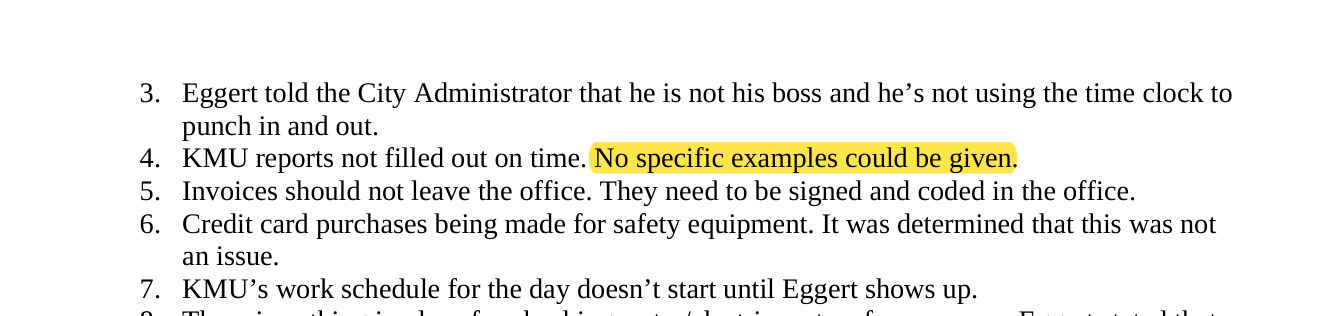
The public record shows no failure by Randy Eggert to keep the utility running. Across the KMU minutes the City produced for 2025 and 2026, the complaints concern reporting lines, property and paperwork. Commissioner Henke's June 2025 list said "KMU reports not filled out on time. No specific examples could be given." On November 18, 2025, with Riggs, Helgeson and the mayor present, the mayor said the personnel committee had met with Eggert on "performance issues." The minutes list three: personal property on city property, an employee injury not reported to the administrator, and whether he would comply with the five agreements [44]. Helgeson's statement, read at length, named no outage, no safety failure, and no service the utility failed to deliver, and Resolution 2026-34 gives no performance reason [26].
Apparently Eggert says KMU's priority is electric and water but crews help with other work. It is his own description, offered in a budget session, and it supports the report's point about the work without measuring it.
I don't know where it got in the transaction, but KMU employees have always worked with the public. We help snowplow. We do whatever. Yeah, absolutely. Right. And there's always that willing, you know, our top priority is electric and water. But we're always willing to help out. Right.
The November entry also supports the past-practice point. On the injury report, Eggert filled out the required form and said "this was the way injuries were previously handled," and the outcome recorded was that "a procedure needs to be made for all employees to follow." The City itself may have concluded that no procedure existed. The question left open that day was who he reported to, and the minutes end with him and Lehner told to "sit down and talk this through."
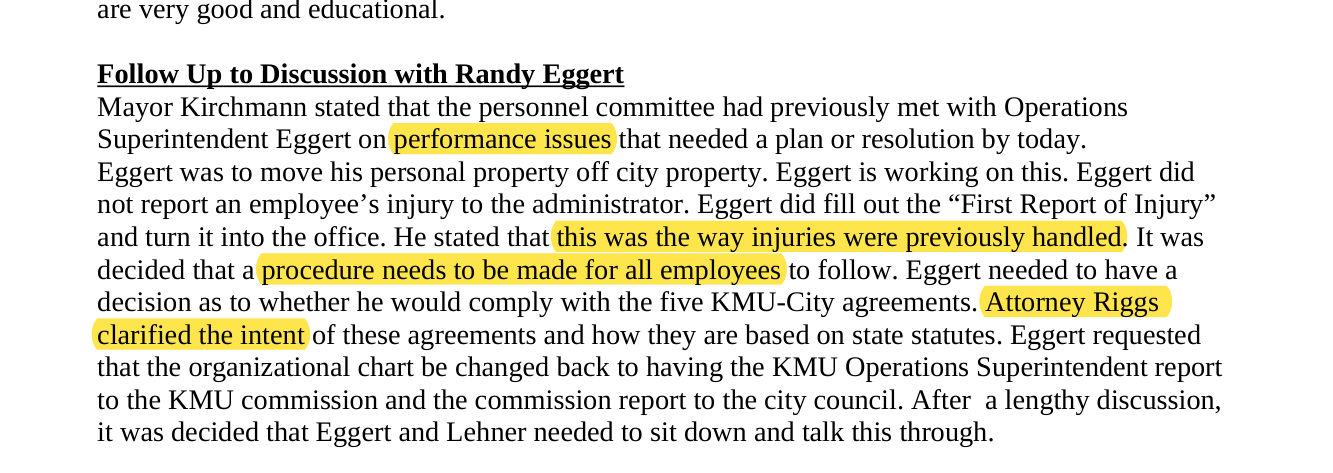
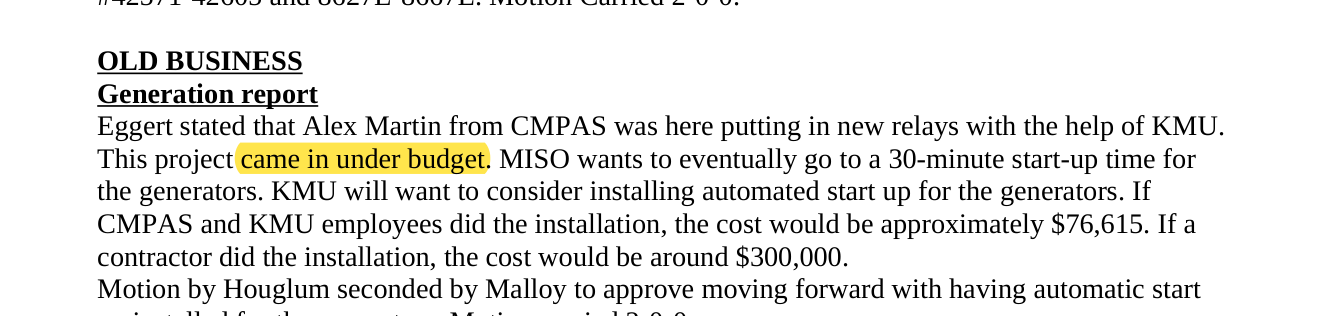
The same minutes show a small utility being run. CMPAS's profile says he rose from lineman to electric superintendent in 2000, and served as a CMPAS board director [37]. In January 2025 new relays "came in under budget." That year emission controllers were installed, generator automation advanced at about a quarter of a contractor's estimated cost, and the annual oil test on the substation was done. Two apprentices completed their first year, and service went in for new businesses. All of it was done by a crew of about four, with someone on call every night and weekend.
A speaker, in unclear audio, thanks Randy's crew for restoring power in an hour. It is one anecdote favoring the crew, and the caption's "two weeks before" depends on Helgeson's Jan 28 date, which is her word only.
I have some comment for you. You guys, thank you so much. There was a horrible storm. And I was all alone. And I heard a loud bang. And my electricity went out. And I thought, whatever. I'm not going to go into the nightmare that I was in. But anyway, I didn't have your number, Randy. But then Wayne called you. And you guys fixed it in one hour. And I watched you out my window with my dog. And thank you. It was so awful. I felt terrible. It was like wind blowing. And they had to climb a pole. And it was terrible. But thank you. Hey.
Lehner says KMU will have Randy and three young men, technically full staff. He supplies the crew size the report relies on, and the remark may suggest thin experience, but it says nothing about Eggert's performance.
So we will be at technically full staff, but we'll have Randy and three young men running KMU. So.
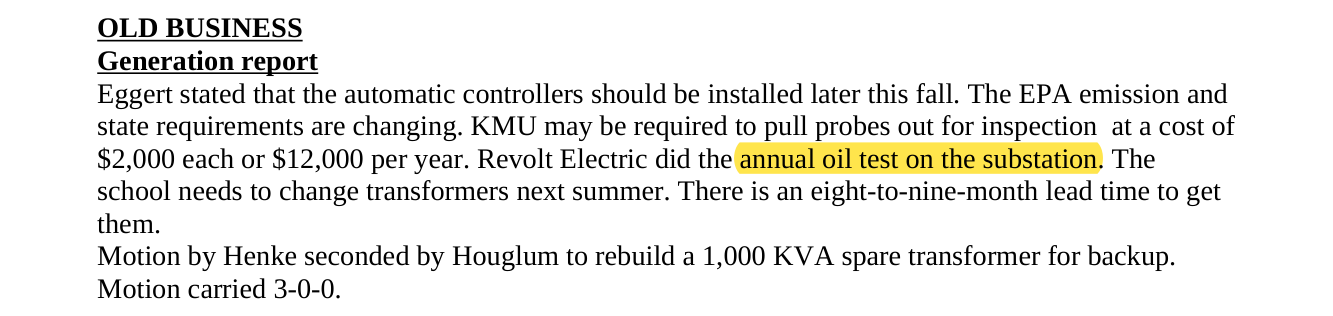
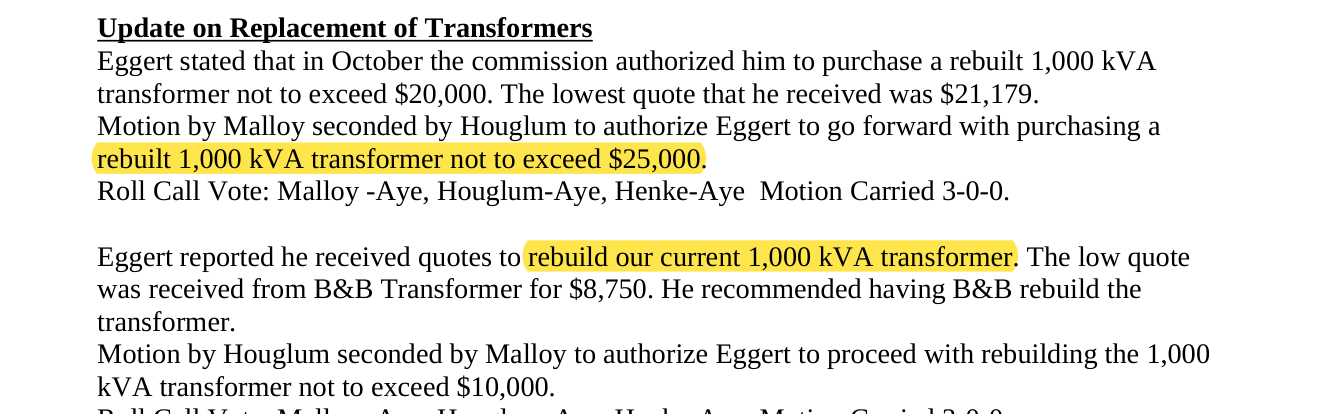
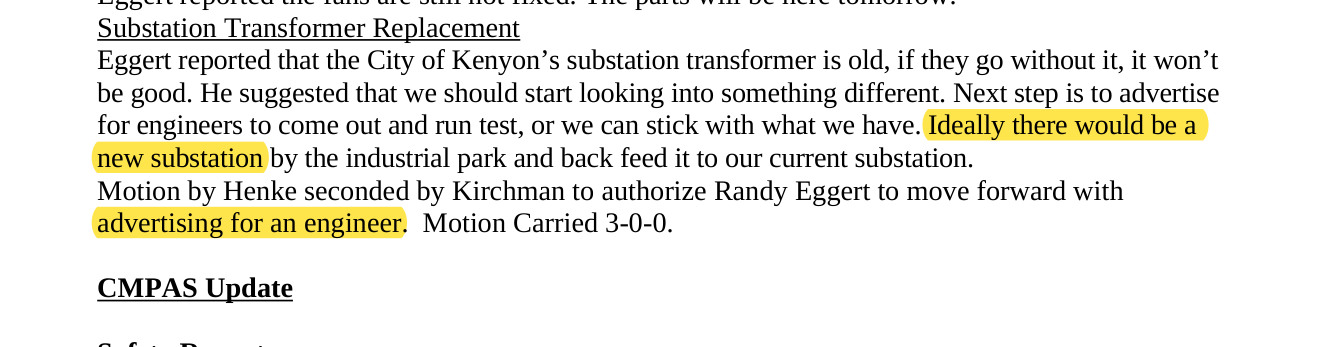
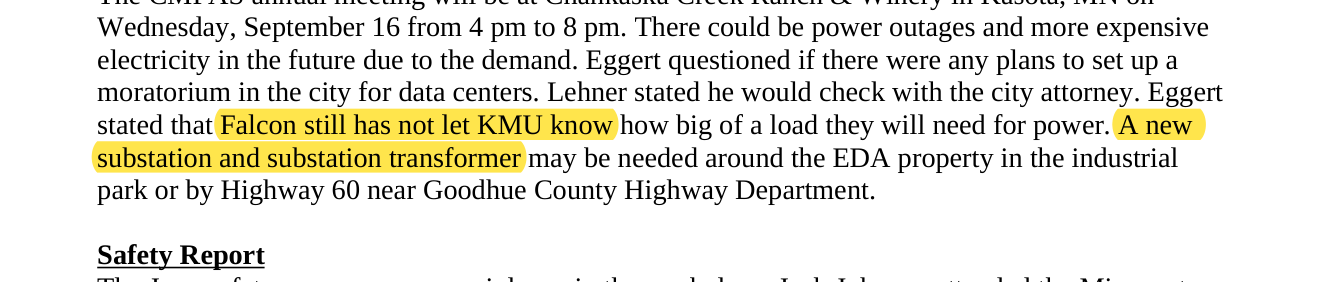
He also appears to have seen the City's current problem coming. In September 2025 he proposed buying a rebuilt 1,000 kVA transformer "as a spare," and that fall the commission authorized the purchase and a rebuild, on quotes he obtained. Those are distribution units, smaller than the substation transformers Compass discussed, but when a Compass presenter told the council on October 29 that a spare would be "partially a different discussion" 16:19, the man who had been working on spares was not allowed to speak. On June 16, 2026 he told the commission the substation transformer was old and that "ideally there would be a new substation by the industrial park," and the commission authorized him to advertise for an engineer. On August 14 he authorized the long-range plan scope. The customer's transformer was ordered and delivered. Compass's own words were that the present effort is "work that KMU staff had already started" [4].
A CMPAS presenter says a spare would be partially a different discussion. The report notes Eggert, who had worked on spares, was not heard, but his units were smaller distribution transformers, and the audio is unclear on who spoke.
If you had a spare, that'd be partially a different discussion.
Anderson says the customer's transformer has been ordered and delivered. This favors Eggert on results, but it does not show whether quotes or approvals came before the order.
You already have the transformer for the new customer that has been ordered and delivered.
Anderson calls the work a continuation and says the plan had been discussed and the engineer hired. This favors Eggert's account that work was under way, but it says nothing about whether Lehner was told or any step was missed.
Really, we're just doing a simple continuation of our team this episode. The plan for the substation had already been talked about. The engineer was hired to do the design.
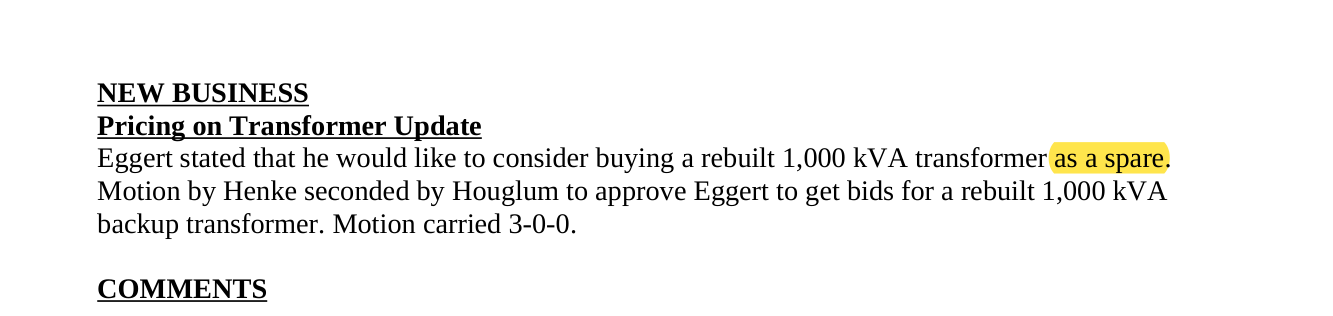
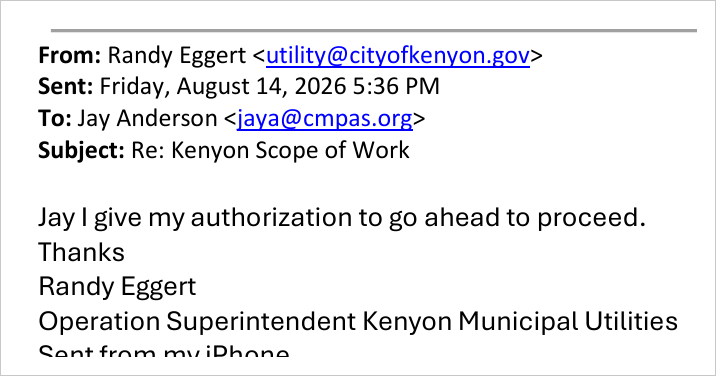
The conflict the record does describe is about supervision and timekeeping. The May 2025 agreement placed KMU staff under the administrator, and by June the minutes record a dispute over who his boss was and a time clock. That may mean his difficulty was with a new administration and a new system, and not with the work. His own evaluations, the Sept 21 packet, and outage and service records would complete that picture.
Lehner says in January 2025 that KMU staff were saying they did not report to him. It is his account of overheard remarks, and it shows the reporting conflict predates the 2025 agreement, which fits a dispute about supervision.
When I have had conversations and overheard conversations in the office from some KMU staff, they're under the impression that we don't report to the city administrator. We do our own thing. You can't do this. You can't do this. We don't take any direction, so on and so forth. Not exactly how it was proposed to me and really not really what I signed up. But what you're asking me to do, the way it's set up right now, is basically to be your city administrator with one hand behind my back. I got to sit down with public works and I need to sit down with KMU and we got to work out something and come to a resolution. If the attitude is I don't listen to you, I don't report to you, you don't tell me what to do. I don't know how we get anywhere.
The time-record argument
The time-record accusation may not be a valid accusation at all. Eggert worked for the city for 48 years, and the public record shows no complaint about how he recorded his time until 2025. Ethan Eggert told the September 21 meeting that he "had a good record for 46 years," and asked what changed in the last two [12]. If his method of recording time was the same throughout, then the City reviewed it, approved it and paid it for more than four decades. An employer that accepts a practice for that long may have set the very standard it now claims he broke. Arbitrators testing discipline under union contracts ask whether an employee was forewarned of the consequences of his conduct [34], and although Eggert was at-will and that test does not bind the City, it describes a basic expectation of fairness. A rule first enforced in a man's fifth decade on the job, against a method his employers had always accepted, may be less a finding of misconduct than a change of management. The word "adjusting" would then describe his ordinary method and not any wrongdoing.
The allegation with the most weight may also be the one most tied to how the City kept time. Helgeson said he cost citizens thousands of dollars by "adjusting his time entry for those days to appear that he was in at seven" 35:36. The system itself may have been changing beneath him. In 2023 the council reviewed software that "would take the place of timecards" [28]. By June 2025 KMU's staff were on a time clock, and that May the council had approved the agreement placing KMU employees under the administrator's supervision. A process followed for decades may have been replaced midway through a 48-year career, and an employee who kept to the old one could then be found at fault under the new one.
Helgeson said he admitted fault twice at public meetings. That is her characterization; Oct 20 minutes record him acknowledging responsibility for some issues, and the Sept 21 packet or any recordings would show what he actually said.
Randy had been placed on an employee performance improvement plan back on January 28th for nine areas that he has admitted twice during city public meetings that he knows he's at fault for and failed to even try to improve on these. I'm going to just name a few. Being to work on time for his set shift and failure to get prior approval for any overtime hours from his supervisor. This is a known process by all employees. This item has cost the citizens thousands of dollars by him adjusting his time entry for those days to appear that he was in at seven.
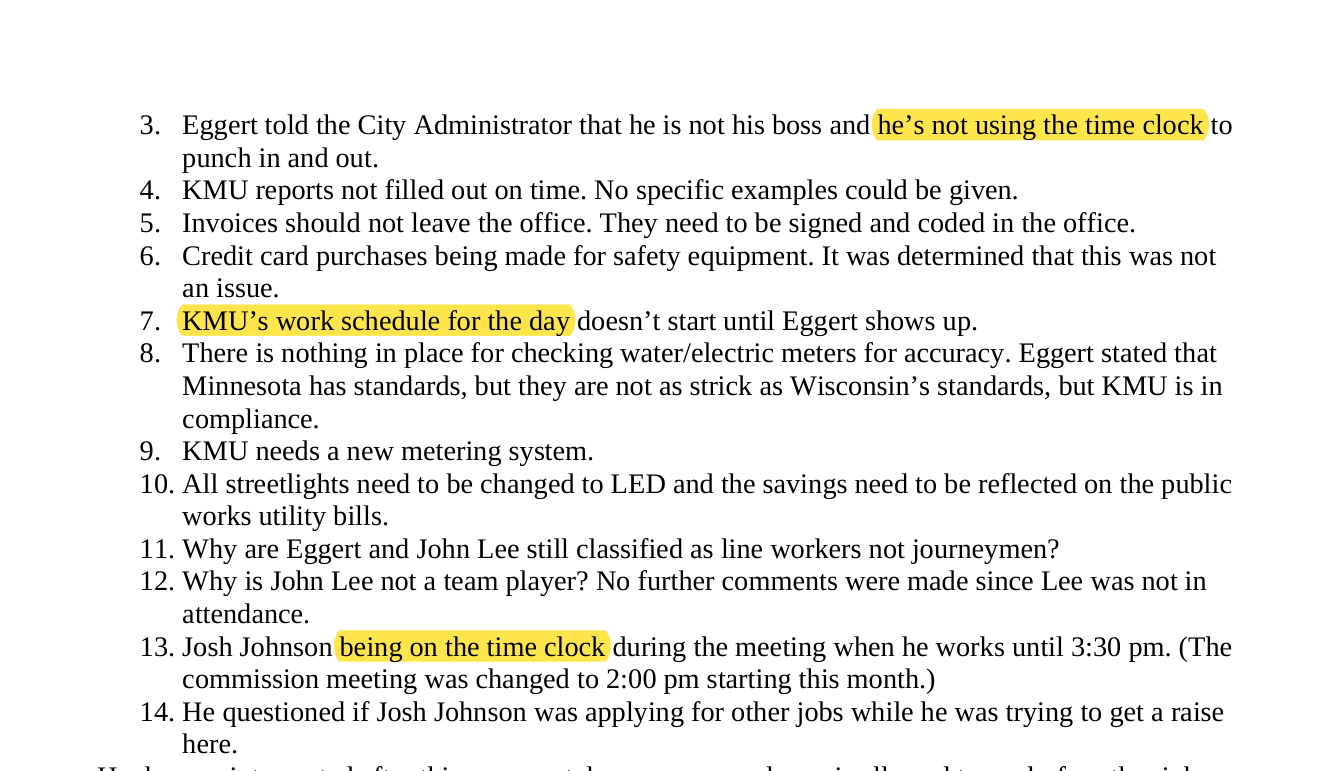

The June 17, 2025 minutes are the only record of the dispute found so far. They record Commissioner Doug Henke saying that Eggert "told the City Administrator that he is not his boss and he's not using the time clock to punch in and out," and that "KMU's work schedule for the day doesn't start until Eggert shows up." That is Henke's account of what was said, in a list that also records another item for which "no specific examples could be given." No recording of KMU meetings has been found, and none of the 24 council videos from 2025 and 2026 discusses the time clock before October 29. It may be that Eggert refused a new system outright, or it may be that a veteran superintendent disputed who supervised him, and the record may support both. The list came from a commissioner and not from Lehner or Helgeson, though Lehner, Helgeson and the mayor were all in the room.
An unconfirmed KMU voice says KMU has operated separately but will get in line if given direction. If it is Eggert, it may cut against a flat refusal in January 2025, but the speaker is not established.
We've always operated. We as KMU as a separate entity. Now, if that isn't so, that's something for Scott Riggs to let him up with. That would be his point next. If we're not, we've got to get in line. And, hey, we'll get in line as quick as anything else. Give us a direction to go. Okay.
Federal law supports the point that a time clock was a choice. The Fair Labor Standards Act regulations say "Time clocks are not required" [29]. For employees on fixed schedules, they allow an employer to record the normal schedule and note exceptions [30]. If Eggert's practice was to enter his scheduled start and he worked his hours, including call-outs and evenings a utility superintendent routinely works, entering seven may have been the recognized method and not a falsification. Whether he was hourly or salaried, who approved his time for years, and how "thousands" was calculated would all bear on this. If supervisors approved those entries for decades, the City may have accepted the practice it now condemns.
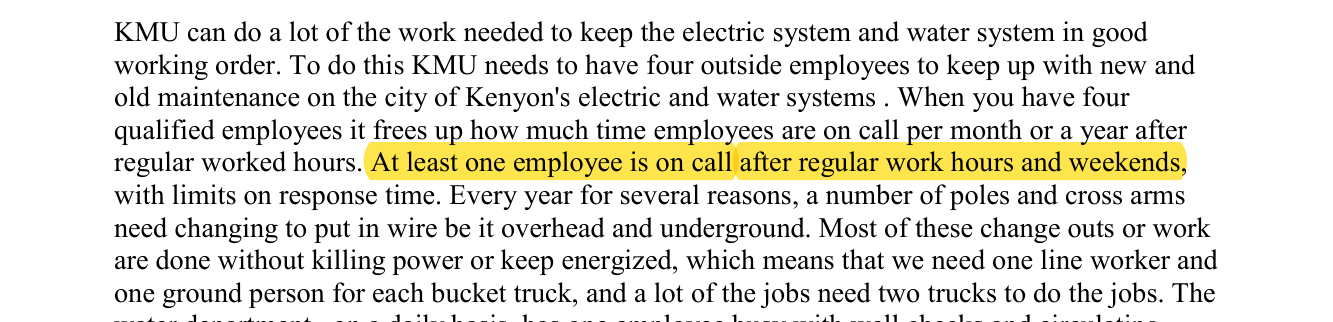
The job itself may explain much of this. A KMU staffing text in the December 9, 2025 packet says "At least one employee is on call after regular work hours and weekends, with limits on response time," on a utility of about four outside employees, and by October 2026 one employee was "handling ALL on-call responsibilities" [8][32]. A superintendent on such a system does not work a clean seven-to-three-thirty day. The Supreme Court has recognized this kind of work for decades. Armour v. Wantock and Skidmore v. Swift (1944) hold that waiting on call can be work, depending on the facts, and 29 C.F.R. § 785.17 treats restrictive on-call time as hours worked [33]. Anderson v. Mt. Clemens Pottery (1946) holds that when an employer's records are inadequate, an employee may prove his hours by reasonable inference [33]. If his unrecorded calls were counted, he may have worked more than his records show. Research also finds that on-call work carries real fatigue and recovery costs [33]. Helgeson said he refused an offer to change his set hours 36:12, and what that offer was may show whether the City tried to fit the schedule to the job.
Apparently Eggert says he usually carries the phone and that call-outs need two or three workers. This supports the idea that unrecorded time may exist; whether it counts depends on the facts under § 785.17, and no call logs are in hand.
I'm on call. If I'm not on call, I shouldn't take the phone, but I have it all the time. Say, Josh isn't on call. If he has a phone, most of the time, he answers. And usually, if we get called out, you need three guys, two or three guys.
Helgeson said he refused an offer to change his set hours and that she told him it affected his children's rates. This is her account, and what was offered would show whether the City tried to fit the schedule to on-call work.
When he was asked if he would like to change his set hours, he refused. I reminded him at that time that this issue is not only affecting him in paying higher rates and taxes, but also his own children that live in town, which didn't seem to concern him enough to make a change.
Inaccurate time records are also common. A survey of 830 hourly workers found 43 percent had adjusted reported hours, and vendor surveys of small businesses report that most correct timesheets regularly before payroll [31]. Those are commercial surveys, and studies of self-reported hours find strong agreement with records overall, though imperfect, and weakest day to day [31]. Across some twelve thousand working days, errors may be expected in anyone's records. Eggert's records would show whether his were scattered, or ran one way.
Other employees' records may matter most. If others on the same system, or under the same supervisor, entered time the same way and were not disciplined, the enforcement may have been selective, and Helgeson's "known process by all employees" 35:07 would apply to everyone. Commissioner Houglum said on Sept 21 that the conflict "started two years ago at the first KMU meeting that Lehner attended" [12], Helgeson spoke of his refusal "since day one" 37:12, and Eggert told KMU he felt "bullied and micromanaged" [8]. Those accounts may describe a personal conflict that the time cards became a way to resolve. The time records of every KMU and public works employee, and the discipline each received, would establish it.
Helgeson said he refused the changes from day one and would answer only to commissioners. Nov 2025 minutes show him asking to restore that reporting line, which supports part of her point, though it may describe a structural dispute and not misconduct.
Since day one, he has refused to accept the changes that the city council and the KMU commission had approved. These are the five agreements between KMU and the city that were approved many years ago, but had not been followed by the last administrator. Randy has said multiple times that he would not report to Scott. He would only answer to the commissioners, even though the agreement clearly states who his supervisor is to be.
Possible slander and libel
Spoken defamation is slander, and written or published defamation is libel. Helgeson's statement may be both. It was spoken in a public meeting, it was read from a prepared text, and the City then posted it on video for anyone to watch. Some of what she said may qualify as defamation per se, the category covering accusations of a crime or of unfitness in a person's trade, where reputational harm may be presumed. The strongest candidate is the claim that he adjusted his time entries so he would appear to have arrived on time, costing citizens thousands of dollars. That describes falsifying public records.
Helgeson said he admitted fault twice at public meetings. That is her characterization; Oct 20 minutes record him acknowledging responsibility for some issues, and the Sept 21 packet or any recordings would show what he actually said.
Randy had been placed on an employee performance improvement plan back on January 28th for nine areas that he has admitted twice during city public meetings that he knows he's at fault for and failed to even try to improve on these. I'm going to just name a few. Being to work on time for his set shift and failure to get prior approval for any overtime hours from his supervisor. This is a known process by all employees. This item has cost the citizens thousands of dollars by him adjusting his time entry for those days to appear that he was in at seven.
Other statements may also be actionable. She said the transformer "was not ordered to statute" because three estimates were required, while § 471.345 asks for two quotations when possible, and the City's purchasing policy, whose adoption is unconfirmed, also says two [6][7]. She said "we" had just found out about the order. That may be true of her, since she is not listed in January, but KMU's January minutes recorded the plan to buy it with the administrator and the current mayor present [25]. Her statements about the bucket truck, personal property and insubordination may be actionable to the extent the records contradict them.
Helgeson said three estimates and council approval were required and that they had just learned of the order. The statute says two quotations when possible, and January minutes mention the purchase, but defamation would need falsity and fault, and whether quotes existed is unknown.
The issue of the delay in getting service out to the industrial cart is not the reason why Randy's no longer a City of Kenyon employee. The transformer, which we just found out at the last KMU that he had ordered, first off was not ordered to statute for something of this size. There should be at least three estimates received and then presented to the KMU commission and then the council for final approval before placing an order, not just ordering on his own, along with no notification that had hit have been done.

The case would be Eggert's to bring, and he has until October 29, 2028 under § 541.07. His release reaches only claims existing when he signed, so Oct 29 falls outside it [26]. The four decades of accepted practice may be the center of that case. To say a man adjusted his entries "to appear" on time conveys deception. If that entry was how the City had always accepted his time, the statement may leave a false impression of dishonesty, even if the individual entries can be found.
Her privilege may depend on the same question. Minnesota requires that a privileged statement be made on a proper occasion, from a proper motive, and on reasonable or probable cause, and the person claiming it carries the burden [35]. Whether she had valid reason to believe the practice was improper, including whether anyone looked at how time had been kept for forty years, may decide that element. A settled matter on a catch-all agenda may also fail the proper-occasion test. Her knowledge would be tested too: a failure to investigate alone may not establish actual malice, but purposefully avoiding the truth can [36]. Her prepared text and the attorney's reported review make what each of them examined central. Lehner's Oct 13 remarks may support a separate claim to the extent they conveyed that Eggert caused the failure.
A member objects to blaming one person just let go, and a voice, apparently Lehner's, says he should have been included. This bears on whether Oct 13 remarks pointed at Eggert, but the audio does not clearly show who said what.
So who is responsible for this? For missing? Where was it dropped? Yeah. Honestly, where was it dropped? Yeah, I'm going to, I'm not going to point fingers. Because we were, I just want to be respectful. But I'm thinking you guys would be able to figure out maybe, where the ball was dropped, yeah. But something with that magnitude shouldn't lie on one person. If you're talking about one person that was just let go, that shouldn't fall on one person. That $3 or $5 million expenditure? Or, I don't know. Wow. That's all I can say. Wow. I can say it was with one person. It was sort of necessary, but it wasn't. I should have been included in those conversations a long time ago. Yeah.
The disclosure may also raise a data practices question. Section 13.43 keeps most personnel data private, and whether this data was public depends on his status as a "public official" and on the release in his agreement [11]. Eggert's position description would decide it. His surgery was mentioned, and that sits apart from any complaint data.
Helgeson said Eggert was not told to sign or be fired. If the report's reading holds, this answers Debbie Eggert's letter directly, but the match is an inference, and who wrote the text and when would establish it.
Randy was not told he had to sign the separation agreement or he would be terminated. He was presented with the agreement and it was explained that if he chose to not sign it, the next action was that it would go to the entire council who would then hear the personnel committee's reasons for recommending releasing him from his duties and would then vote on it. If council majority were yes, then he would be let go immediately and his benefits would immediately end. on paid leave until his scheduled surgery and his benefits continued through December.
The statement also may have served to shift the blame. On October 13, Lehner told the council that a contract "sent out on July 2nd" had "no response and no signatures," and "We have missed deadlines" [3]. Two weeks later the explanation moved: Helgeson said the delay "is not the reason" he left 34:35, and replaced it with a list of other faults. A departing employee may have been the implied explanation at each stage.
Lehner says a July 2 contract went unanswered and deadlines were missed. Read with his Oct 12 "sent to Randy" email, it may point at Eggert without naming him here, and the report's blame-shifting reading rests on that inference.
Also told that we had a contract that was sent out on July 2nd of this year with no response and no signatures and nothing being brought back. We have missed deadlines.
Helgeson said three estimates and council approval were required and that they had just learned of the order. The statute says two quotations when possible, and January minutes mention the purchase, but defamation would need falsity and fault, and whether quotes existed is unknown.
The issue of the delay in getting service out to the industrial cart is not the reason why Randy's no longer a City of Kenyon employee. The transformer, which we just found out at the last KMU that he had ordered, first off was not ordered to statute for something of this size. There should be at least three estimates received and then presented to the KMU commission and then the council for final approval before placing an order, not just ordering on his own, along with no notification that had hit have been done.
The administrator's apology
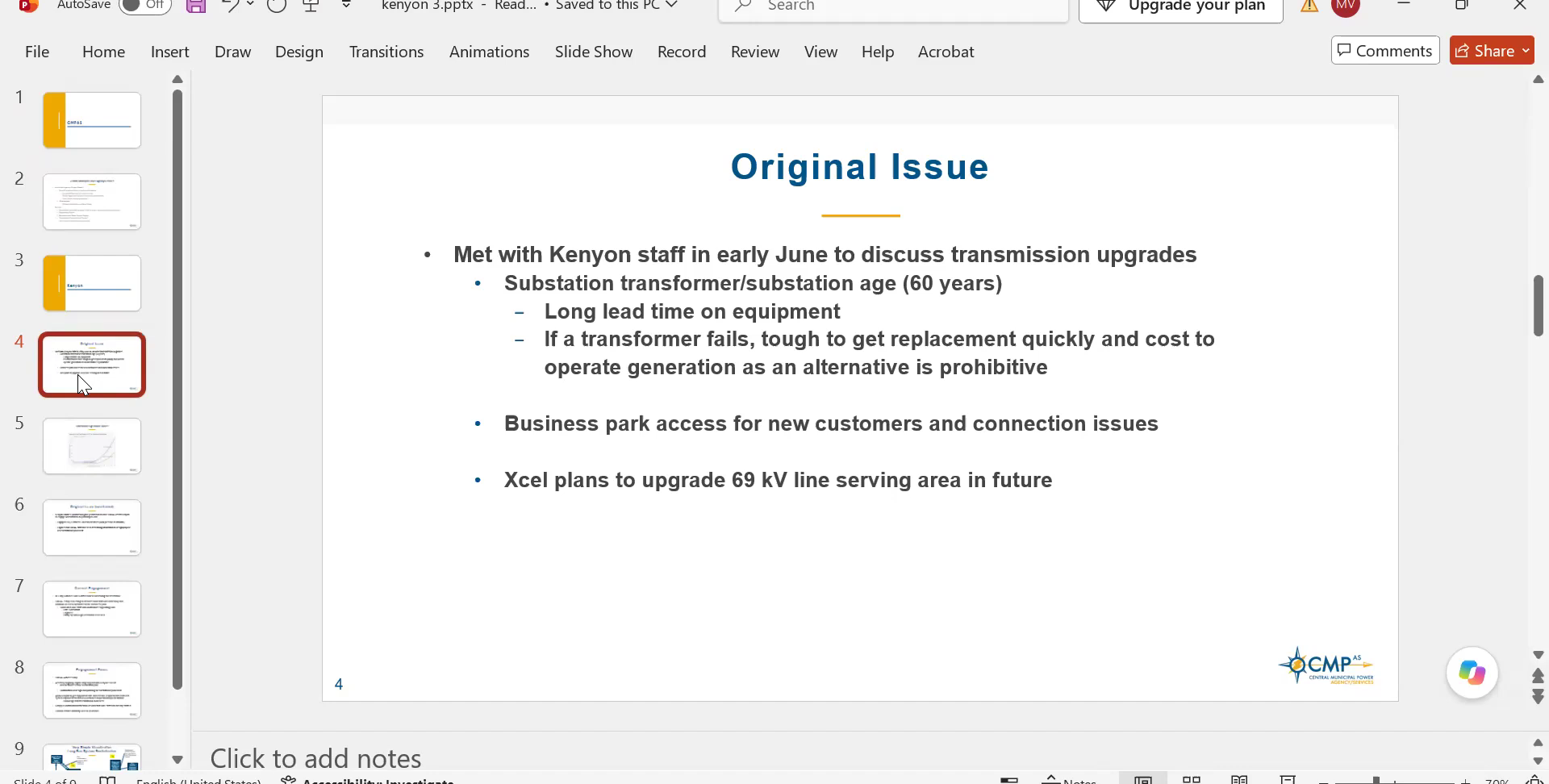
Compass spent 27 minutes explaining that it met with Kenyon staff in early June, that the commission approved planning that month, and that the current effort was "simply a continuation/transition of work that KMU staff had already started" [4]. The July 2 contract appears to be a form sent to all members, and on September 9 only three had returned it [5]. Lehner then said: "my apologies if I came to the council possibly with information that maybe I didn't fully understand 100%" 52:24. He said he had received a lot of information in a short time, and that he was being attacked personally 52:57. The meeting then moved toward adjournment.
Anderson walks through the slide dating the first meeting to early June. This bears on Lehner's Oct 13 account because Compass puts its work months earlier, though "Kenyon staff" does not establish that Lehner knew of that meeting.
So let's talk a little bit about what's been going on in Kenyon. So, just kind of to give a rundown of it and talk about the original issue. We got a call, or we've met with Kenyon staff and discuss transmission. There's a couple things going on. One big thing is substation transfer. The lead time on them has, what, doubled or tripled out?
Lehner apologizes for possibly not understanding information and says he is under attack. The apology names no statement and corrects nothing, but it is conditional and not an admission of falsity, and he gives a reason: much information in a short time.
So all I wanted to do with this conversation that came in front of the council at the Industrial Park was to bring the council up to speed on what I was recently informed of. I was provided with a lot of information in a short amount of time. I was being brought up to speed very quickly with people from Compass and other things that I wasn't up to speed on. I recently now have been added to that, so I get the updates and all that type of stuff. Apologies if I came to the council possibly with information that maybe I didn't fully understand 100%. There's been a lot of things that have been said about me out there that are put out there that I believe are extremely false. I'm trying to do my job and I was asked to do it to the best life. Continue, please. Now I'm being attacked personally and publicly because I was trying to move the city of Kenyon ahead. I don't claim to be perfect, but I am trying to do the best I can. Because this meeting was supposed to discuss the special meetings. We've already gone through everything on the agenda. I am ready to adjourn the meeting. If there's any comments that we've made, what's happening in town? We are revolving gossip or anything else. We will discuss it at that time. This was a special meeting to cover a few topics.
Lehner finishes after "Continue, please," and a voice, apparently the mayor's, says he is ready to adjourn. He had the floor while Eggert did not, but whether that was uneven treatment depends on who controlled the floor, and the audio is unclear.
I'm trying to do my job and I was asked to do it to the best of life. Continue, please. Now I'm being attacked personally and publicly because I was trying to move the city of Kenyon ahead. I don't claim to be perfect, but I am trying to do the best I can. Because this meeting was supposed to discuss the special meetings. We've already gone through everything on the agenda. I am ready to adjourn the meeting. If there's any comments that we've made about what's happening in town revolving gossip or anything else, we will discuss it at that time. This was a special meeting to cover a few topics. So if there's nothing else to be said...
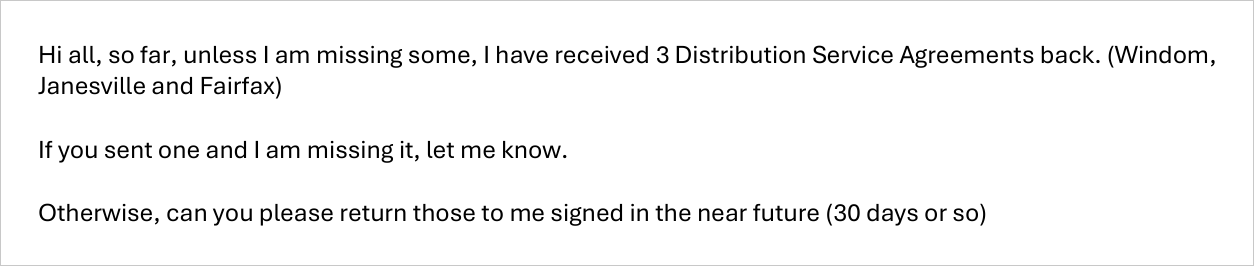
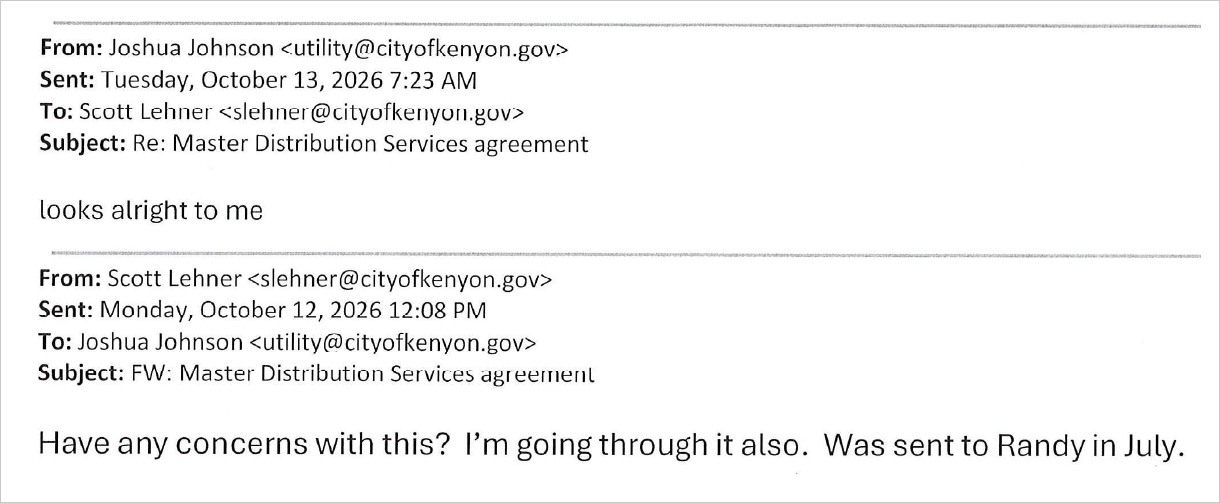
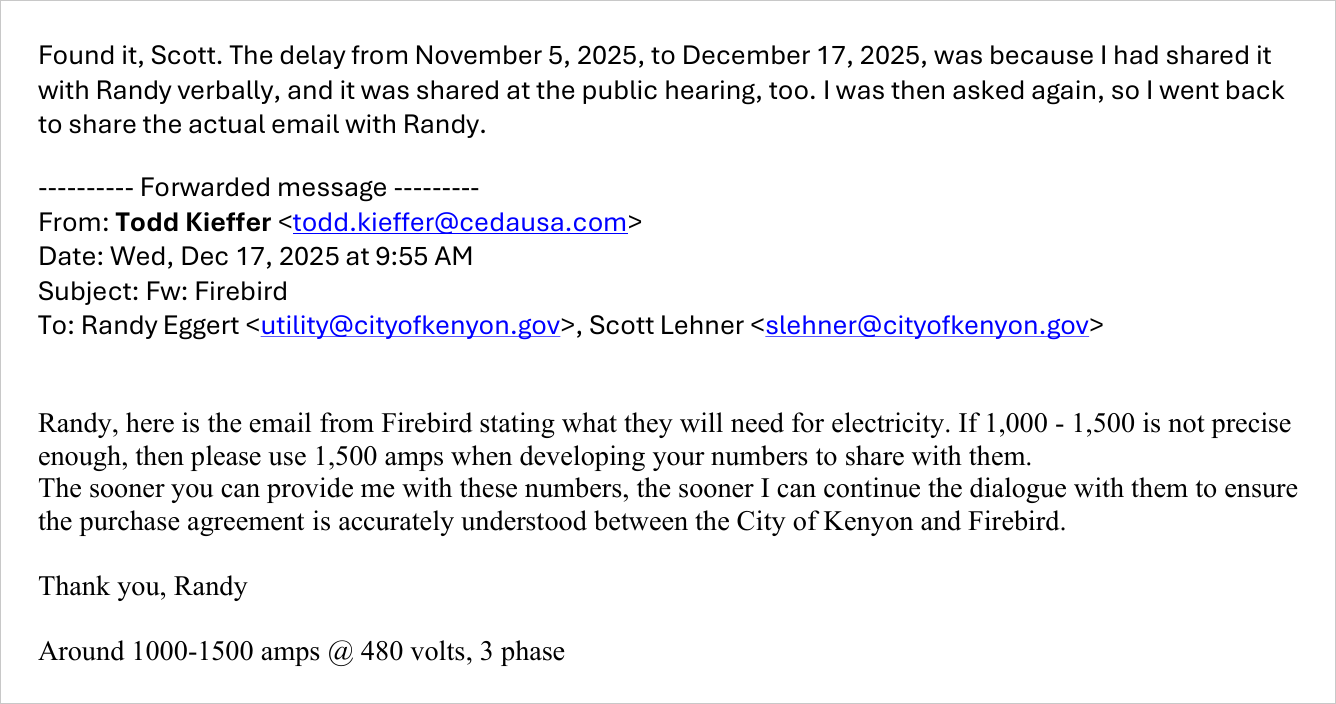
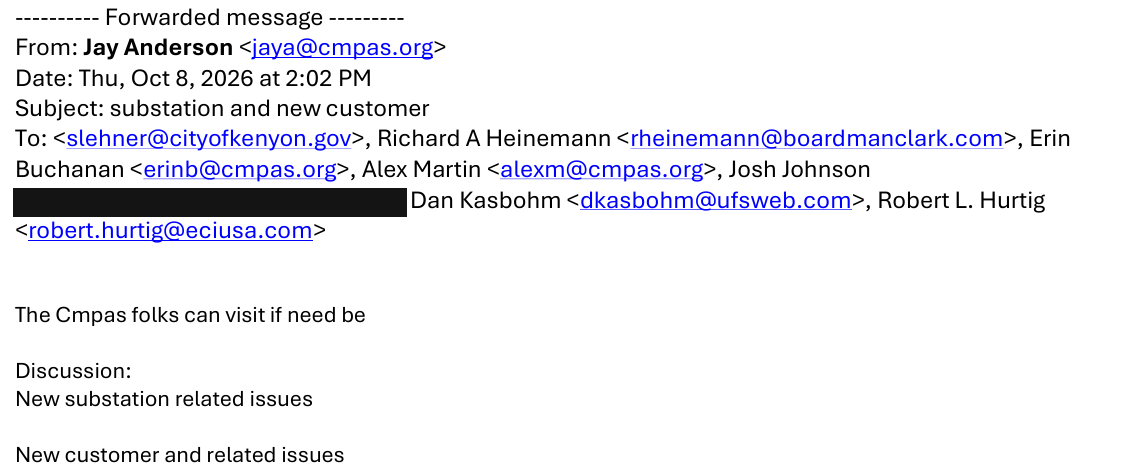
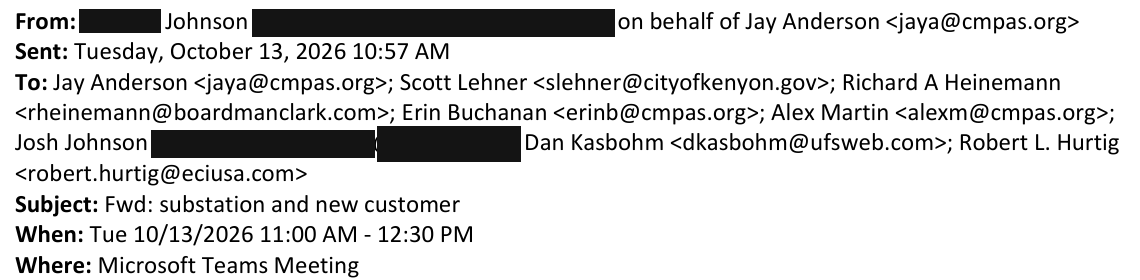
That sentence concedes something, whatever its hedges. The city administrator conceded, on the record and after hearing Compass, that he may have brought the council information he did not fully understand, on a subject that may have been heard as explaining a departed employee's failures. His explanation is difficult to square with what had already reached him: the load figure forwarded on December 17, 2025, the January and July KMU meetings at which he was present, and an October 8 invitation about the "substation and new customer" [24][25]. Whether his October 13 statements were mistaken, careless or worse depends on what he read and recalled, and the record does not show that. Either way, the admission names no statement and corrects nothing.
Lehner says he was hearing it for the first time. July minutes and the December email may strain that, but what "it" covered is unclear, and proving knowledge would need evidence of what he read or recalled.
So some of you are looking at me like you're hearing this for the first time. That's how I looked last week and today when I was hearing it for the first time.
Lehner says Compass first heard of this at last week's meeting. He hedges with "potentially," which would matter to any claim of falsity; Compass's slides say otherwise, and the source of his impression is unknown.
For example, I think we were all under the understanding that we had ample electricity and a plan to be able to bring electricity to the industrial part for the individual or the company that's coming in there. When we had our initial meeting last week with Compass, that was the first that they were hearing that any of that information was going on. That was far into that project and potentially Compass is hearing about that for the first time.

The harm may be substantial. Those statements gave the town an explanation for a problem, and left a man on leave to answer it only as a citizen at a KMU meeting, and a newspaper repeated it. The $1 million figure has carried three meanings with no itemized estimate, and residents have not been told what a $5 to $6 million substation would do to their electric bills. Compass itself raised the question: "Do we need to borrow money? Do we need to raise rates?" 19:53. His conduct may also fall below the standard the council is entitled to expect of its chief administrator, which the council can address in his performance review.
Lehner says one transformer would be upwards of a million dollars, attributing that to what he was told that day. Oct 20 minutes treat the figure as the cost of service, so it may have changed in the retelling.
This one transformer, to give you an idea, this one transformer they're telling me today is going to be on the upwards of a million dollars to be able to get that transformer in here. So very concerning information coming out of some of that.
Anderson asks whether Kenyon must borrow or raise rates. The harm the report describes is this unanswered gap, though he raises it as a planning step, and nothing here shows what bills would do.
You may have to tweak your rate forecast and look and say, okay, are we good? Do we need to borrow money? Do we need to raise rates? What do we need to do to deal with us?
Apparently Lehner says the utility cannot pay cash, must borrow, and must first stop running negative. It is a candid Oct 13 warning, which favors him, and it gives no amount or rate effect.
When this substation or some portion of this comes forward, we are not going to have cash money to pay our way through this. We are going to have to go to somewhere and say, we would like to borrow money. That's why that whole negative thing I was talking about, it's hard to borrow money when you're running in the negative. So that's the first thing we got to get corrected, right, is running not in the negative any longer. But there's no way we're going to pull this stuff off that we sat and had these meetings in. without borrowing somebody. There's just no way.


The Compass question
Only one party explained the City's largest pending decision, and that party may stand to gain from how it is decided. CMPAS is a member-owned joint agency, and Kenyon pays it. Its Master Distribution Services Agreement bills work at "then-current Time & Materials ('T&M') rates, plus applicable administrative service charges" [38], and its board was "watching distribution service numbers" in September [39]. ECI's Kenyon study is filed under a CMPAS project number, with its fee of up to $50,536 and its work coordinated through CMPAS [40]. On October 20, KMU added Lehner as an alternate on the CMPAS board [8]. The man whose October 13 account Compass was invited to explain may now sit on the body that governs Compass.
Lehner says most of the Compass work is billable to the electric utility. CMPAS therefore stands to be paid for it, but nothing shows excess charges, and the invoices would establish what was billed.
So we have a contract with Compass and some of this stuff when we meet with them is included in the contract, but most of the stuff I'm talking to you about right now is going to be billable time to us, meaning electric utilities are going to have to pick up that bill. And how about
Anderson says KMU staff reached out, ECI was hired, and Kenyon pays ECI through CMPAS. He states this openly, which favors him; it places the consultant's fee under the adviser, and invoices would show whether CMPAS adds anything.
and just to be clear, you know, KMU staff reached out to the original issue was, you know, they needed, we got a consultant engaged with them, you guys approved us to go find it, they hired UCI that you guys are paying for them through us. They have an engineer that's been here, he's looked at the system, he's working out to give the information to design a new substation.
Lehner says he was asked to join CMPAS's board for an interim period, and KMU added him as an alternate on Oct 20. Whether that is a conflict may depend on his role and any votes, which the clip does not show.
I was also asked at this point, on top of my other responsibilities, if I would be open to joining the board and being part of their planning for an interim until we get a replacement in there with Josh's assistance. So at the next KMU commission meeting, we have to put together a resolution to have myself and Josh added to that so we can be part of the meetings and the discussions and things like that. that go along with that.
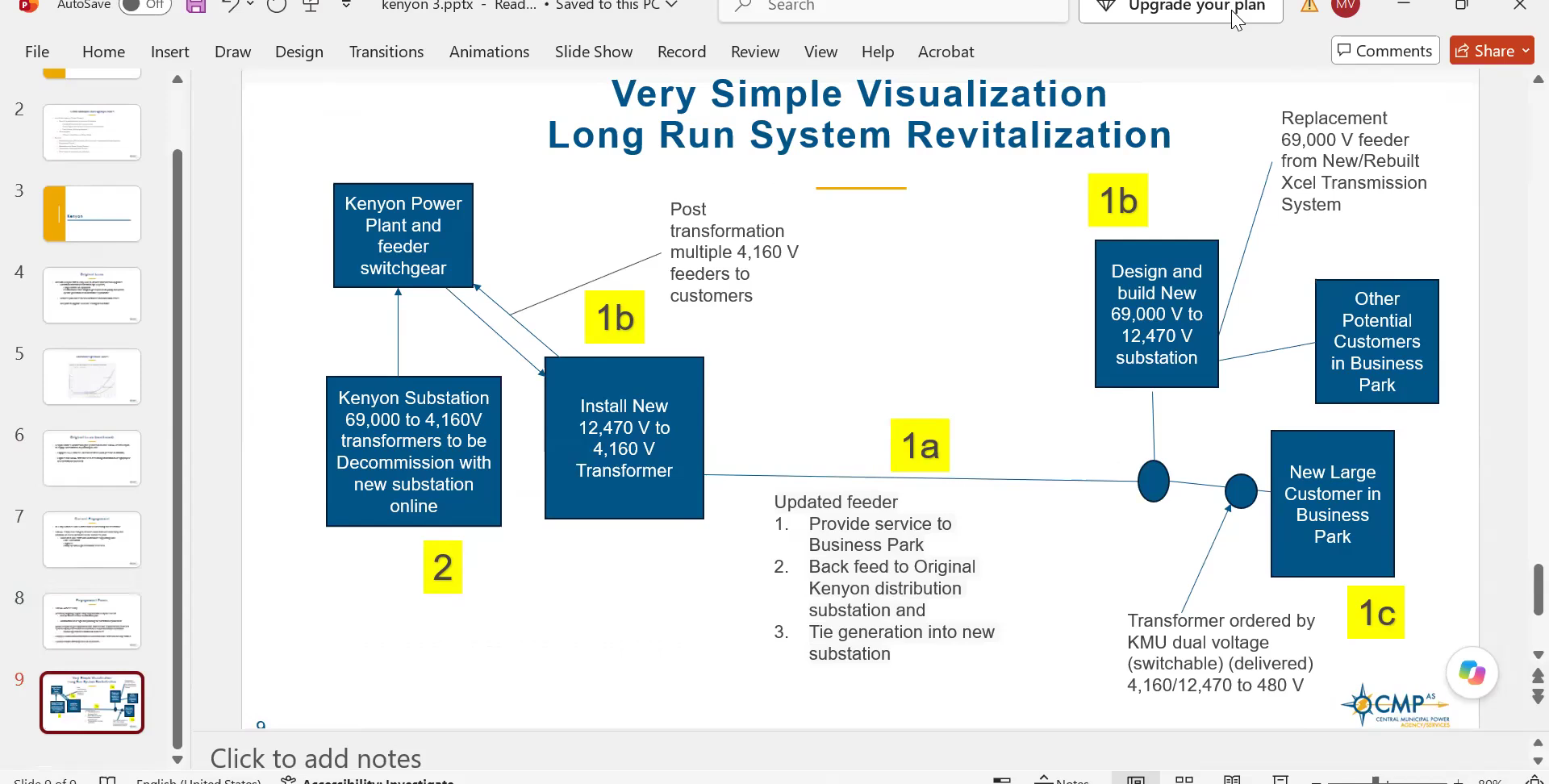
The presentation was prepared. It was on the agenda, the file on screen was named "kenyon 3.pptx," and Anderson said they went through one slide "about 12 times" 22:05. Lehner then asked him to explain how they arrived at "roughly $750 to $1 million," adding "You do it better than I do" 28:31. Anderson repeated that CMPAS only advises and that the council decides 20:18. That may be true, and it leaves a council with no independent opinion. No outside engineer reviewed the plan, and nobody was asked to argue for a different one.
Anderson says "we" went through this about 12 times, without making clear who "we" is. The presentation was prepared, which is unremarkable for a technical briefing and does not by itself show anyone shaped its content.
So let's talk a little bit about the big discussion that I've seen him kind of talk on. And I'll try to walk you through it. We went through this together about 12 times.
Lehner hands the $1 million question to Anderson, who answers with grouped items. An adviser is explaining the administrator's figure with no independent review, but his rough answer does not show the number was wrong.
But initially, I've been getting questions about how did we come up with roughly $750 to $1 million on the initial part. And I know that's the step up. But can you explain that to them? Sure. You do it better than I do. No. In all honesty, we brought Scott and Josh in and talked to them. And we went through a whole bunch of different scenarios and situations. When we talked, he said, look, we think the substation is probably $5, $6 million. Right, Alex? The transformer stopped at $1.2 million. That's for that transformer and that stuff. This other transformer here is probably $300,000. That was part of this discussion about this line because we weren't sure if we're going to have to do that right away. Given the load, we've heard of, and we're going to validate through that. That would serve if that load is correct. We need to double check that load. We won't have to do that transformer right now. But in all honesty, all this stuff kind of has to happen really quickly. And if we want to get that transformer order to soon. Let's pretend this substation does fit. You guys have some of this stuff here. We facilitate trying to get this hooked up faster. Especially if we've got this interstate system built. We've got that substation transformer, we've got that substation transformer. We've got that substation transformer available. We've got that substation transformer available. We've got that substation transformer available, as well as the transformer to convert to the system built. That's where kind of the million came from. We kind of group you two together. And that is really kind of the piece that you can do.
Anderson says CMPAS only advises. That is a fair limit on its role and favors CMPAS, but it may leave the council without independent advice, since no outside engineer reviewed the plan.
We are an advisory role only. We do not make decisions for you guys. We do not spend your money.
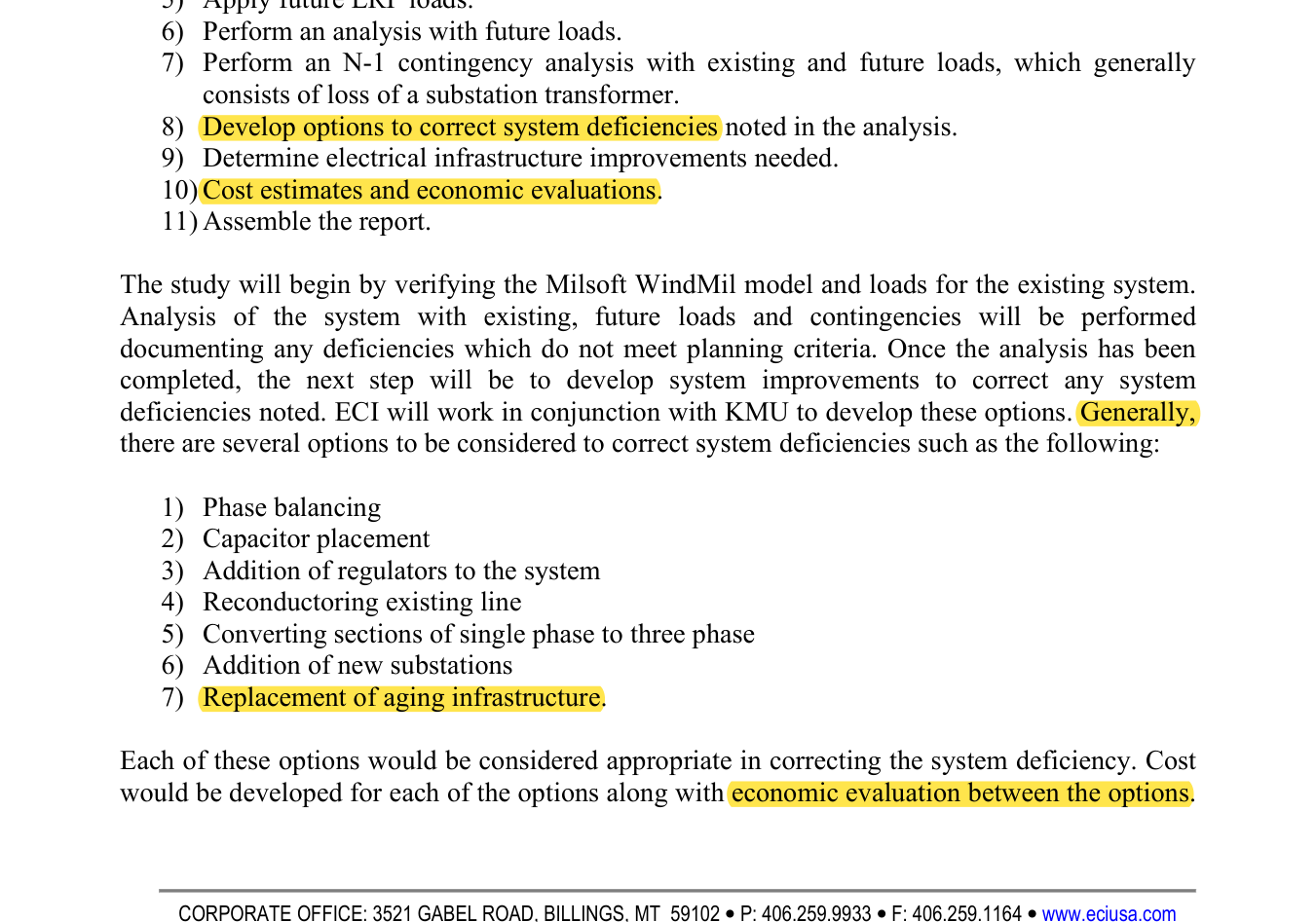
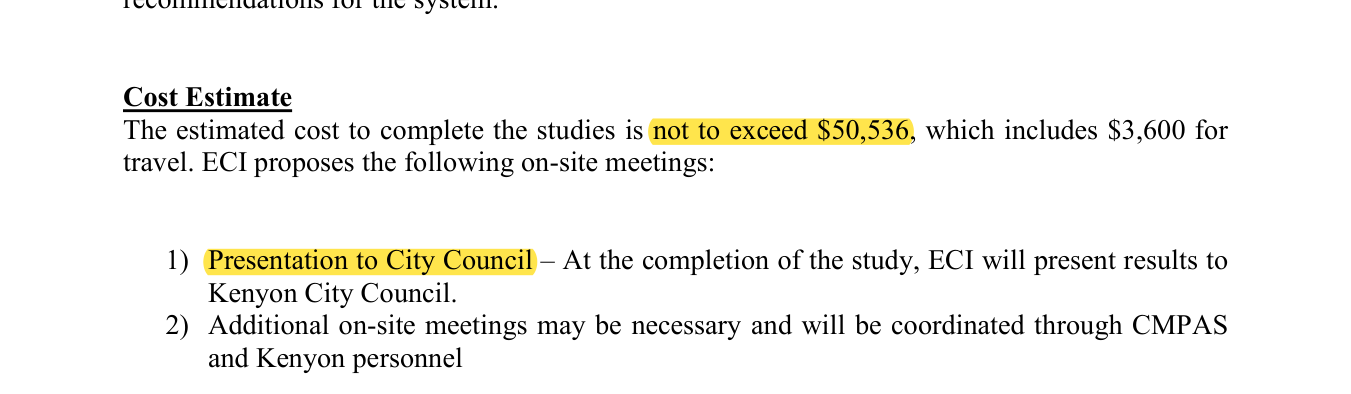
The study meant to supply that comparison may have been passed over. ECI's August scope lists "several options to be considered," from phase balancing and reconductoring to "addition of new substations," and says "Cost would be developed for each of the options along with economic evaluation between the options." Its steps include an N-1 analysis, "loss of a substation transformer," which is the spare question exactly. Its first listed meeting is a presentation to the council of the results "at the completion of the study" [40]. On October 20, KMU's minutes already had the engineer and Compass "developing a design plan and preparing a request for quote," and on October 29 Anderson said they were "getting ready to propose a design" 17:29. No study, comparison or economic evaluation was presented. A public body may be moving to one answer before receiving the document it paid to compare the answers.
Anderson says a design and transformer order are about to be proposed. This may show movement toward one answer before the study is presented, though the finished ECI study and its dates would establish the order of events.
And they are getting ready to propose a design. They'll propose a transformers to be ordered.
The market data
The market may be the strongest reason to want that comparison, and the primary data shows why. Anderson told the council transformer prices had "doubled or tripled" 10:10. The federal Producer Price Index for transformers and power regulators reached an all-time high in September 2026, 89 percent above January 2019 and 7.6 percent above a year earlier [41]. That is near doubling, not tripling, across the broad category. The index for large power units alone ended in 2023, so no public figure isolates the equipment Kenyon needs.
Anderson says prices doubled or tripled. The federal index shows near doubling for the broad category, so tripling may run high, but no public series isolates large units and his figure may fit those.
And the prices have doubled or tripled. Part of this started because of the COVID epidemic. But then on top of it, what we're starting to see is a lot of supply issues. And there's more and more people needing transformers, more and more data farms. You guys have all heard about all that. The need for transformers, generation units, switchgear, all that has skyrocketed. So the leak time's gotten longer and it continues to be a delay.
| Measure | 2019 | 2024 | Latest | Status |
|---|---|---|---|---|
| Transformer price index | 230 | 394 | 434 | All-time high |
| 5-company capex, quarterly | n/a | $61B | $230B | Record |
| U.S. electricity sales, TWh | 3,816 | 3,954 | 4,123 | Record |
| U.S. residential price, ¢/kWh | 12.97 | 16.30 | 18.04 | Record |
| Minnesota residential, ¢/kWh | 13.18 | 15.30 | 16.28 | Record |
| Minnesota sales, TWh | 67 | 65 | 67 | Below 2014 peak |
| MISO capacity, $/MW-day | n/a | n/a | $126 | Down from $215 |
Our calculations. Price index: WPU1174, Jan 2019 and annual 2024 average, Sept 2026 preliminary. Capex: Microsoft, Alphabet, Amazon, Meta and Oracle, Q3 2024 and Q3 2026, from SEC filings. Sales and prices: EIA-861M, 12 months ending Aug 2019, Aug 2024 and Aug 2026. MISO: four-season average, 2025-26 and 2026-27 [41][42].
Data center spending is the visible driver. The five largest builders reported $230 billion of capital spending in the third quarter of 2026, up from $106 billion a year earlier, and that number is still accelerating. These records may mark the top of the market, and the City would be buying at it. Minnesota's own picture differs from the national one: prices here are at a record while sales remain below their 2014 level, so the state may be paying more for a surge in demand that is happening mostly elsewhere.
The price history gives the council something to measure. Since 2000 the transformer index has seen two real declines: 10 percent after the 2008 crash, recovered by 2011, and 11.5 percent from 2012 to 2015, recovered by 2019 [41]. On a $1.2 million transformer, a decline of that size would be about $140,000, and a year of the current increase about $90,000. This cycle is far larger, so a correction may be larger too, and if the data center spending stops, it may be sharp. Whether waiting would save money, and how much failure risk the City would carry meanwhile, is exactly what an economic evaluation exists to answer. The council was shown none.
A dais question draws a 3.5% figure at age 60, in unclear audio. It was the only failure number offered, and no one set it against the cost of failure or waiting, which an economic evaluation would do.
What is the fail rate percentage at 60 years? It's up there. It's 3.5%. So a lot of 100 transformers that are still at level 60, 3.5 out of 60.
Other options exist and may deserve pricing. Rebuilt and remanufactured transformers are sold at quoted savings of 10 to 40 percent, with much shorter delivery, and substation transformers can be rented [42]. Those are sellers' figures, but KMU has itself rebuilt a 1,000 kVA unit for $8,750. The American Public Power Association runs a member exchange for urgent equipment [42], and CMPAS's own 11 members might share a spare. Compass itself said one transformer could wait 29:52, and Xcel's line rebuild is not expected until about 2031 11:05, which may allow phasing. KMU's rules limit what the utility spends on a new service, with the excess paid by the customer [43], and Anderson's own October 5 list included "contribution in aid of construction if possible." A Compass presenter said a spare would be "partially a different discussion" 16:19. No one priced any of these in public.
Anderson says one transformer can wait, pending load validation, then says things must move quickly. The clip supports both readings, and the load check would help decide whether phasing is possible.
Get in the load we've heard of and we're going to validate through that form Josh that That would serve if that load is correct. We need to double-check that. We won't have to do that transformer right now But in all honesty all this stuff kind of has to happen really quickly and if we want to get that transformer order to soon follow the business
Anderson says Xcel's upgrade around 2031 would be a good time for a new substation. An estimated date five years out may allow phasing, though it also gives a reason to plan now.
And lastly, Excel is planning an upgrade as a 69 system that runs near you guys in the next, I think about 2031 is kind of the estimated date. So when they come through, they're going to have a new line. So kind of all lines do. It'd be a good time to go up to that new line, have a new substation, bring the power to it.
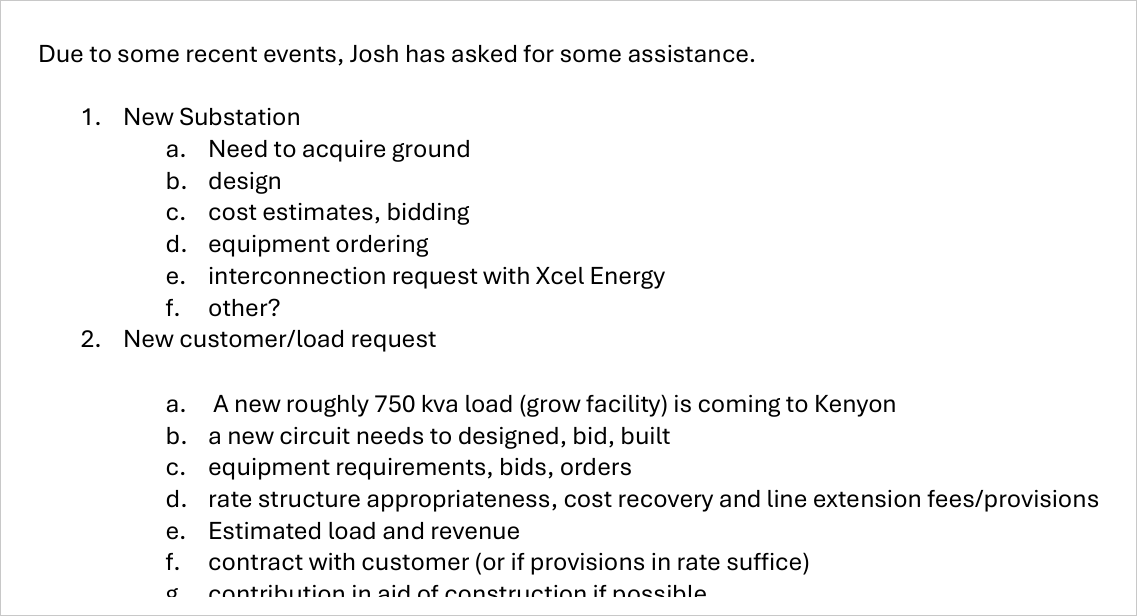
The completed ECI study, an independent engineering review, and every invoice CMPAS and ECI have sent Kenyon would establish how far this goes. A $5 to $6 million decision for a town of 1,900 may deserve at least a second opinion from someone with nothing to bill.
Anderson gives $5 to $6 million for the substation. This is the figure behind the report's call for a second opinion, and it is a spoken estimate that does not show the project is unnecessary or overpriced.
When we talk to someone, we think the substation is probably $5-6 million. The transformer itself is about $1.2 million. That's for that transformer and that stuff. This other transformer here is probably $300,000, $400,000.
The attorney
Scott Riggs may be the most consequential person in this account who was never elected. At each stage of the City-KMU conflict the record places him in the room, often writing the documents, and it shows no second lawyer giving either body a different view. The questions below concern whose interests that advice served. He may have sound answers to all of them, and most of his advice is privileged and unseen. The privilege belongs to the City, so a council could choose to release it.
Did one lawyer advise both sides of the merger?
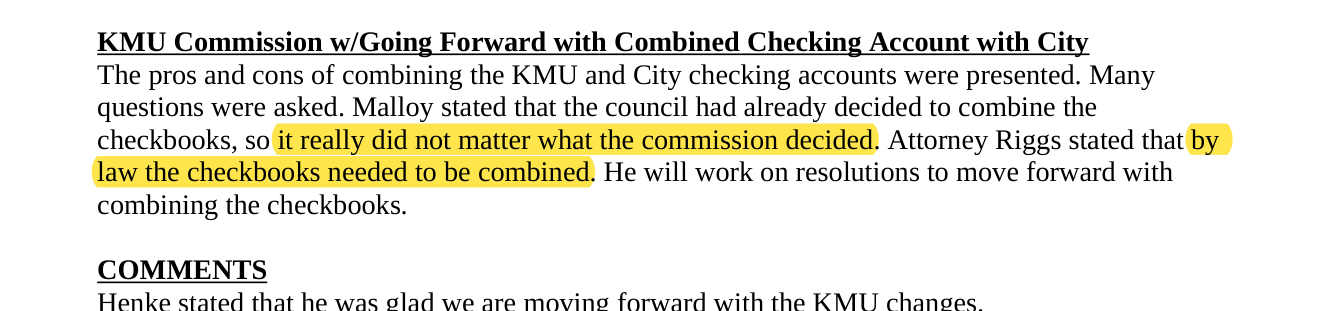
Minnesota law gives a utilities commission its own powers. Section 412.361 says the commission may "employ all necessary help," "fix their compensation," "fix rates," and "enter into necessary contracts" [46]. KMU's minutes show Riggs advising the commission on these subjects while serving as the council's attorney [44]. On April 15, 2025, Commissioner Malloy said the council had already decided to combine the accounts, "so it really did not matter what the commission decided," and Riggs told the commission that "by law the checkbooks needed to be combined." Nothing in the record shows the commission ever had its own lawyer. Riggs called KMU "an arm of the city" in January 2025. If that is right, he had one client. If the commission holds independent statutory powers, he may have had two with opposing interests, and Rule 1.7 would require him to address that conflict, including informed consent confirmed in writing [16]. That question was the heart of the whole dispute, and he answered it by calling KMU an arm of the city, while serving as the council's attorney. The commission may never have been told it could ask anyone else.
Riggs calls KMU an arm of the city. If so, he may have had one client; if the commission holds independent powers, Rule 1.7 may apply, and the clip does not show any conflict was discussed.
Thank you. I'll jump in there. Yeah, well, Scott and Frank spoke to me about this sort of the historical interactions of the city and it really came new. There were a lot of discussion points the council had back, you know, starting in 1997 to about the year 2001. That's the five agreements that Scott has in his staff report here. The idea was to bring the two entities, and again, the KMU only exists because the city's here. It was established in 1934 by ordinance under Chapter 412, as Frank said. There are other ways to establish a utility. That's not what's happened here. This is a statutory utility under the arm of, it's an arm of the city under Minnesota Statutes Chapter 412. The idea was to bring the entities more closer together because a lot of staff was being utilized across the board, and it still is. That's the whole point.
Was there ever a law that required this?
No statute reviewed for this report says a utilities commission's checkbook must be combined with the city's. The minutes record Riggs telling the commission that "by law the checkbooks needed to be combined," and they cite no law. The closest statute may point the other way. Section 412.371 is titled "Separate city fund for each utility." It says "A separate fund or a separate account shall be established in the city treasury for each utility," that all receipts and disbursements run through it, that the commission "shall... audit claims" on it, and that orders are paid on the countersignature of the commission's president [46]. That puts the money in the city treasury, which may be what he meant. It also expressly contemplates a separate account. Section 412.141 likewise recognizes payment on orders of "officers of independent boards or commissions," and § 412.361, subd. 5, treats transfers of utility money to the general fund as something the commission agrees to [46].
The City's own paperwork may be the best evidence. Resolution 2025-13, stamped with his firm's numbering, cites no statute at all. It says "KMU wishes to close its bank account and merge its funds with the City's funds" [45]. A requirement of law and a wish are different things. Three weeks earlier a commissioner had said it "really did not matter what the commission decided." If the law required this, the resolution would be expected to say so, and if it did not, the commission may have been told it had no choice when it did. The resolution also retired KMU's own federal and state tax identification numbers, which suggests KMU had been treated as a separate entity. It says nothing about keeping the separate fund, the commission's audit, or the president's countersignature.
The finance director says auditors recommended combining accounts and that fund accounting protects each fund. This favors the City on the recommendation's source, and it is an auditor's advice, not a statute's requirement.
With having the audit, the auditors every year have come back and said, you need to combine these bank accounts. It's going to create so much more efficiency, going to make things a lot easier. And with fund accounting, it will protect that money that sits in each fund. We have our general government fund, which is that 101 fund. Then we have our KMU fund, which is 601 and 603. And then we have our general fund, our government fund, enterprise fund for our wastewater and street water and all those other funds. That money stays within those enterprise funds and doesn't go anywhere. And with how the audit is set up, they will make sure that that money stays where it needs to be and it doesn't go to the general government fund. And the general government money doesn't come into enterprise funds. Very secure. It's done well. We talked to Brad at Abdo. He's the audit partner and he's done the KMU audit and the city audit when they were separate and now together since 1998. and they've been pushing for this merger since we became in the same building. Thanks.
Apparently Lehner says the resolution is about efficiency and that KMU stays separate and keeps control of its money. He describes no legal compulsion to the council, and the clip cannot show whether that control lasted.
Moving on to Resolution 2025-13, authorizing the merging of Kenyon Municipal Utility Bank Accounts and appointing authorized existing bank accounts. We just need a motion for that. We'll need a motion for that. I don't have anything to add. You did a good job of explaining that. That's just authorizing Whitney and myself to move forward, talking about what we were talking about all through this whole process is merging things together, even though KMUs will stay separate. The efficiencies that we talked about, so Whitney doesn't have to do things two and three times and all that, if you remember those conversations a few months back, that's what this is authorizing. It keeps them in control of their money. Okay.
Lehner reports the account closed in June 2026, later than the resolution's Aug 31, 2025 date, with Eggert signing. This shows the merger's completion and his cooperation, which may sit awkwardly with a claim of blanket refusal.
I told you all that I would let you know once the KMU bank accounts were closed and kind of moved over. That happened this past week. Randy was kind enough to go down to the bank because he's a signer on there to be able to sign, put a signature on a few things to be able to close that out. So I can officially tell you that that bank account, the KMU bank account now is closed. And
Apparently the finance director says statute calls for a treasurer and commissioner to approve, and that checks should still go to the commission. A limit was acknowledged in January 2025; whether it survived depends on practice after the merger.
Is the city trying to take that money over? Or who's going to control where it goes? That is stuck with the funds. It cannot go anywhere. When you go with one checkbook, who approves it? The funds stay within there. So when you're quoting your, when we're quoting invoices, and it's 601 and 603, that money stays specifically in there. The money does get mingled together, but expenses and revenues come in with that 601 and 602. It's no different. Does the commission still okay the checks for you? They will still go through that as statute says. There has to be a treasurer and a commissioner that approves it. Okay. Well, I was confused on when you put them together. Is it going to be the city council that approves it all or whatever? So mostly through consent agenda with them, but they can still, they can and should still go through the commission. Yeah.
The only reasons given on video were practical. On January 14, 2025 the finance director said the auditors "every year have come back and said you need to combine these bank accounts," for efficiency, and that fund accounting would protect each fund. That may be a sound reason, and it is a different thing from "by law." In May 2025 Lehner also described it as efficiency.
A single bank account holding separately tracked funds may be lawful, and may even be good practice, so the statute may not forbid what was done. The question is narrower: the commission appears to have been told the law required it. No Attorney General opinion or court decision on the point was found. His actual reasoning may exist in a memo. Riggs said he would "work on resolutions," and the next firm invoice in the register billed $2,136 to "City-KMU Issues" [15].

Was he defending his own work?
Riggs is credited with drafting the agreements at the center of this. On February 11, 2025 the council's minutes record him saying "Riggs thought these agreements were signed, but signed copies cannot be found" [45]. Lehner said the same. On January 14, 2025 he said he drafted them "at the behest of both entities," attended the meetings, and that they were adopted and signed "but nobody can find them." That may be true, but it rests on memory, so agreements no one could produce became the standard to which Eggert was held. KMU signed new versions on April 23, 2025. Helgeson told the public on October 29 that the agreements were "approved many years ago" 37:12, in a statement she said he had reviewed. On November 18, 2025, Riggs "clarified the intent of these agreements" for a superintendent being asked whether he would comply. Rule 1.7's comment warns: "if the probity of a lawyer's own conduct in a transaction is in serious question, it may be difficult or impossible for the lawyer to give a client detached advice" [16]. The council may not have had detached advice on the validity of a lawyer's own drafting.
Riggs says he drafted the agreements and that not everything he holds is signed. This raises the question of advising on his own work, though the remark is candid, and no rule violation is shown.
So I put these agreements together at the behest of both entities. And my understanding, and I was at the meetings where they were adopted, they were all adopted signed, but nobody can find them here. And I'll be honest, all our files got sent off site. And frankly, my secretary can't find the old hard copies. Everything's been digitized and these don't exist. I have the original ones here, but not everything's signed. But the reality is they were in place and you've been observing them for many years and that's
Riggs recommends returning to the five agreements. He may be defending his own drafting, but Rule 1.7's comment turns on the probity of a lawyer's conduct being in serious question, which this clip does not show.
My recommendation would be get back to what these five agreements were. They may need to be updated a little bit, but that's the point between this board and KMU, which you five, you make that appointment to those three commissions. They're not elected. You are the five elected members in this city. So, yeah.
Lehner says the agreements are signed and in effect. This supports Helgeson's point that agreements bound KMU staff from 2025, but not her "many years ago" unless older versions count, and signed copies of those could not be found.
So I guess the ask, if you would, to the council would just be to, on this one, on number one, just, again, except, you know, we got together with KMU. We've had multiple meetings and all that. And I told you and I made promises to the council that I would bring this back when everything was signed, sealed, and delivered. And I'm happy to inform you that these agreements that are listed on here are, to include the org chart, the commission and through KMU, and is signed by the appropriate parties and are now in effect.
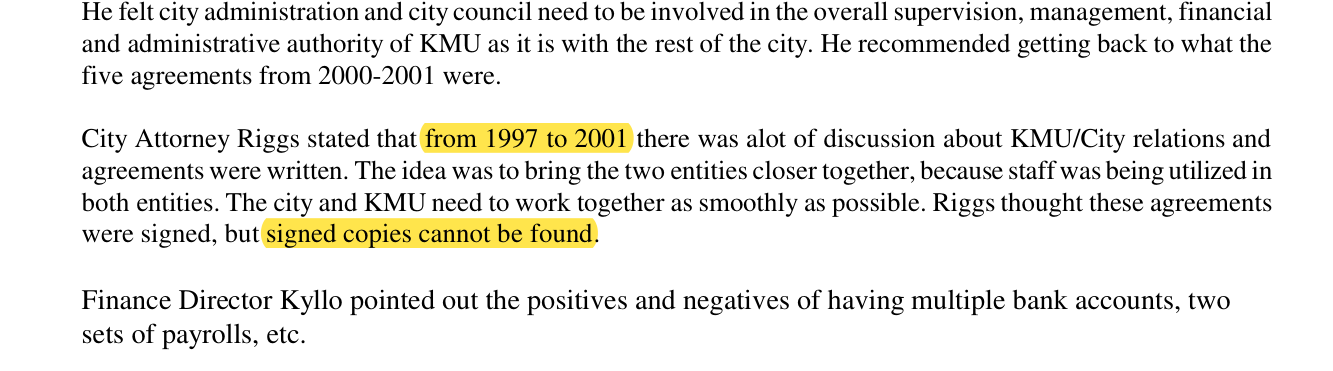
Who actually had authority over Eggert?
Section 412.361, subd. 2, gives the commission the power to hire and direct its employees. Resolution 2026-34, a document stamped with his firm's numbering, states that "the City has the exclusive authority to end the employment of persons working for the City" [26]. A statute gives one body power, and a resolution his firm prepared gives "exclusive" authority to another, resting on agreements the council approved in 2025. Whether an agreement can move that power without the vote § 412.391 describes has never been decided, and the resolution's confident wording does not reflect that. The same issue runs through the transformer accusation. The statement said an order must go to the KMU commission "and then the council for final approval." Section 412.361 gives contracting and purchasing powers to the commission, subject to bidding rules [46]. If he reviewed that sentence, he may have let an inaccurate account of the law go out.
Boyles says the supervision agreement delegates authority over KMU employees to the administrator. This underlies Lehner's authority over Eggert, though § 412.361 gives the commission power to employ help, and no case decides whether an agreement can shift it.
Number four is administrative staff supervision agreement. This agreement delegates all authority for supervision and management of all KMU employees to the city staff and specifically to the city administrator.
Riggs says KMU's board controls some contracting, such as power sales, while the council has a role on bonding. This may sit in tension with Helgeson's line that orders need council approval, but it does not show what he reviewed.
There is some authority, and Randy's mentioned it, for contracting in certain circumstances, power sales, contracts, things like that, that the KMU board controls. Council does have some say in certain things, particularly when bonding occurs for purchases and things like that, and you've always worked well with that. KMU's worked well with the city in those regards. I don't think we've done any recently like that for a while, Randy, but every time that occurred, it would have to come to the council, and the council will have to do certain things because, again, it's an arm of the city.
Whose lawyer was he when dealing with Eggert?
The record shows Riggs at each step of Eggert's departure. Eggert told the council in January 2025 that Riggs had advised him to keep the personnel files locked and hold the keys. Riggs was in the room on November 18, 2025. His firm's stamp is on the separation resolution and agreement. He was present on September 21, when Eggert said he felt pressured, and on October 29. A man who had taken his advice for years may have reasonably been unsure whose lawyer he was. Rule 4.3 says a lawyer dealing with an unrepresented person must correct any misunderstanding of the lawyer's role and may give no legal advice beyond advising him to get counsel [16]. His agreement did advise him he could seek counsel. What Riggs told Eggert before that point, and whether he ever said he was not Eggert's lawyer, would establish whether this rule was met.
Eggert says he was told to keep evaluation files locked and hold the keys, naming "Scott." It bears on whether he saw Riggs as his lawyer, but it is his account, the surname is unclear, and it is not legal advice to him personally.
As to the issue City Administrator Scott has brought about KMU Commission and the way evaluations are being done and who does them and keeps the evaluation of Kenyon Municipal to all utilities employees. Answer to that, they are in a lock file with keys kept by Operation Superintendent, which is me, which was asked to me about five months ago by Finance Director on who has the keys to these files and why does she not have keys to them. I asked City Administrator Scott Riggs, which you already said, Frank, the question. His response to me was I should be the one who keeps the files locked up and the holder of the keys. Unless some policy has been changed that I have not been given a copy of
What did he approve on October 29?
Helgeson said her words were "approved by our city attorney," and he sat at the table without objection. On September 21 he had said "legally personal information couldn't be disclosed" [12]. His view may have changed once the release took effect, because of the public-official rule, but no record shows that reasoning. If he approved the full text, he approved the statement that the transformer "was not ordered to statute" with "at least three estimates," when § 471.345 says two quotations when possible [6]. If he reviewed it, he also approved or missed a personnel statement at a special meeting whose notice may not have allowed it, despite the Commissioner's opinions on the subject [1]. Rule 2.1 requires "independent professional judgment" and "candid advice," and warns that "purely technical legal advice... can sometimes be inadequate" [13]. A lawyer asked only whether something is legal still owes a client his view of the damage it may do. Rule 1.13(b) directs a lawyer to act in the organization's best interest when a constituent's violation of law is likely to cause it substantial injury [14]. The City may now face an adverse opinion, a defamation claim and lost public trust.
Helgeson said the city attorney approved the text. Elseth requires intent to violate the chapter, and this line may cut either way, suggesting good faith or that someone knew to ask; it rests on her word alone.
First off, what I have to say has been approved by our city attorney, along with Randy previously stating that he had nothing to hide.
What is his relationship with the administrator?
Riggs was central to how the City got its administrator. In 2024 he contacted candidates for the interim post, helped interview one, and "drew up a possible contract" [45]. His office reviewed the contract for the firm that ran the search. On Sept 21, 2026, when Commissioner Henke said a leak in city hall was hindering Lehner, Riggs "agreed and he had advised Lehner to have meetings remotely" [12]. That advice may be routine. It also raises a plain question: when the administrator's own conduct is at issue, as with his October 13 statements, who advises the council about him? The lawyer who works with him daily may not be well placed to do so. Riggs missed October 13. No record shows he told the council afterward that the account needed correcting.
Lehner says he and Riggs looked at League mediation, the personnel committee chimed in, and it was tabled as boiling down to one unnamed person. It shows who weighed in, but not that the League would have refused.
that as i know there was a question about league of minnesota cities mediation of league of minnesota cities we took a look at that a little bit um and and then mr riggs and i talked about it also and and then the personnel committee chimed in and i think at this point when we talk about mediation at the league of minnesota cities right now we're going to table that for the simple fact that it actually when questions were asked it really boiled down to one person and they typically don't do mediation because of one person And I'm not the one person, by the way, unless that's what you're thinking.
Riggs says he was ill and absent on Oct 13. This explains his silence at that meeting, which favors him, and leaves open only whether he later told the council the account needed correcting.
Yeah. The reason I asked it if you put on is because obviously I was ill last meeting. I wasn't here. You had a discussion about it. There was a motion made to do that. If you're
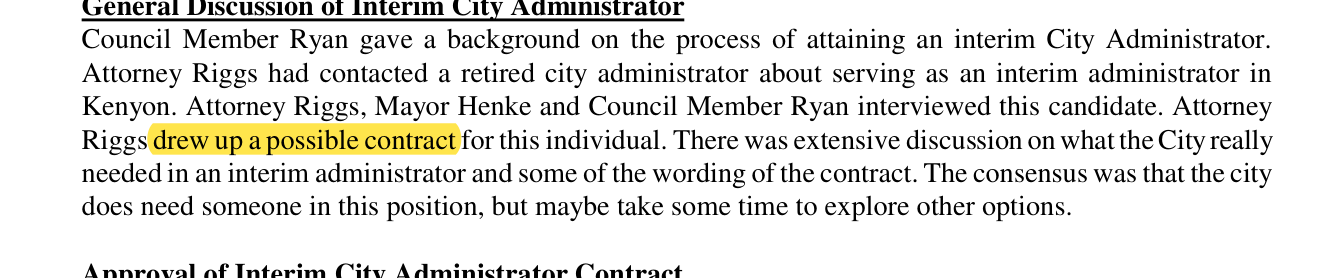
What does the firm earn from this?
The City paid Kennedy & Graven $112,461.31 in 14 checks from November 2024 to July 2026 [15]. The firm is city attorney, EDA counsel, and bond counsel, and it wrote the City Code. It billed $6,000 for the 2025A bonds, and it charges developers' matters at the top rate, now $300 an hour. Disputes are billable: $8,378 for personnel matters, $20,844 for a police data release and a claim, $3,325 for City-KMU issues, and a further $10,836 labeled only "LEGAL" in June 2026. A city attorney who recommends separations, investigations and restructurings is also the one paid to carry them out. That is true of any outside counsel, and it is why independent review matters. On December 10, 2024 the council voted to send out requests for proposals for professional firms, and Interim Administrator Boyles called it "standard practice" [45]. The record shows an auditing RFP a year later. No RFP for legal services has been found, and his rate increases have continued, in 2026 on consent. His rates match his other cities, so the concern is not overcharging. It is that no one has compared his work with anyone else's, and that he has never had to compete for the job of advising the people who decide whether to keep him.
What about the work product itself?
His firm's abatement resolution appears to exceed the statutory parcel cap on its own terms, misstates the citywide cap, and finds an increase in the tax base that the City's own adviser says will not occur. His "before next Tuesday" deadline for the pay ordinance may rest on subd. 3's phrase "before the next succeeding municipal election," though an ordinance adopted after Nov 3 would appear to qualify as well. The minutes have him saying Mary Bailey "should resign effective immediately" to put her seat on the ballot, while her resolution says December 31 and the seat goes before voters on Tuesday. Any one of these may be a minor error. Together they may suggest the City is not getting close review.
Riggs says the council has legal authority. The report says his firm's draft may exceed the parcel cap, which net tax capacity and the certified rate would establish, and the resolution is a draft that can still be fixed.
This is purely a policy decision for you folks to make. You have the legal authority to do it.
Riggs gives a next-Tuesday deadline. Section 415.11, subd. 3, does not appear to require one, so the advice may be an error, minor on its own, and his reasoning was not stated.
There was a motion made to do that. If you're not going to do it, I would say you do a motion to rescind in that direction, because we'd have to do it by state statute with this ordinance, and it would have to be done before next Tuesday to make it effective for the next 12 months or whatever time period is set.
Questions he should answer
- Who is your client when the council and the utilities commission disagree?
- Did you ever disclose that conflict to the commission, or obtain written consent?
- Did the commission ever have independent counsel on the merger? Was it told it could?
- Have you ever advised, in writing, whether the 2025 agreements are consistent with §§ 412.361 and 412.391?
- What law required the checkbooks to be combined? Cite it. Why does Resolution 2025-13 say KMU "wishes" to do it?
- Did the merged accounts keep the separate fund, commission audit and countersignature § 412.371 requires?
- Why were agreements with no signed copy treated as binding on Eggert, and who decided that?
- What exactly did you review before October 29? Did you see the final text and the Salem remark?
- Did you advise against reading it, and did you consider the notice for that meeting?
- What is the legal basis for "not ordered to statute" and "at least three estimates"?
- Did you ever tell Eggert you were not his lawyer? When?
- Have you told the council that any part of the October 13 account needed correcting?
- What has your firm billed for the Eggert matter, and the KMU restructuring, in total?
- Were legal services included in the RFPs approved on December 10, 2024? If not, why not?
- Will you ask the council to obtain independent counsel on City-KMU issues?
The council's silence
The council left the largest questions untouched: the October 13 account, the $1 million, the bill impact, the handling of Sept 21 with its packet handed out at the meeting, the concerns about the administrator that had filled the room 51:54, and whether "the merger" Helgeson mentioned required the vote § 412.391 describes. That word may be the most consequential one spoken all night. In 2025 it usually referred to bank accounts, and Lehner said then that KMU "will stay separate," but if the utility's jurisdiction was moved by agreement, it may have been moved without the voters.
A commissioner, apparently Henke, is called on and defers. KMU's voice is absent from the meeting, and he may have held back because of what Helgeson had just said, but the audio is unclear.
Well, we did have a commissioner that wanted to speak. Excuse me? We did have a commissioner that was going to. Oh, yeah. And then I got a couple other things after that. Doug, did you want to speak on the KMU? You're up, Doug. Oh, okay. Sorry. You don't have to speak if you don't want to. I think maybe we should hold it off until I don't know what Kim had to say. All right. That sounds good to me. That's a question. I agree. Okay. Thank you. All right. And that way you're deferring any public comment to the next meeting like you normally would do. So I think
Helgeson said Lehner was hired for the merger. If she meant more than bank accounts, the § 412.391 vote may be relevant, but the actual agreements' terms would establish that, and in 2025 the word usually meant accounts.
Scott was hired to handle two very important issues along with everything else necessary to run a city. The merger and repairing the fracture between the KMU and Public Works employees.
Lehner says in January 2025 the exercise was never meant to make KMU go away. This favors him as stated intent, though bringing KMU "into the fold" leaves open how much authority he expected it to keep.
never, this whole exercise, me digging into it, all the questions, all the people I talked to, phone calls I made, so on and so forth, was never, ever designed to have KMU go away. This was all designed about, let's all of us operate efficiently. When we looked at the policies and the procedures on it, it was very clear to me reading through that, that that was what the expectations were. I want to be able to have a working relationship with all the folks in KMU. I wanted to continue to build the relationships with all the other entities here in the city. I just would like for all of us to figure out a process where we can bring KMU into the fold with everyone else. And it would be my responsibility to be able to manage all the aspects of the city that I believe that was brought in here to do. So the whole thing about this conversation was not about getting rid of anybody or getting rid of any entity,
Helgeson's text placed the conflict on "one man's refusal to accept changes" 37:45 and ended with "we had valid reasons" 39:16. The city attorney's closing contribution was a suggestion to repost the decorum rules 55:15. This may fairly be called a gross failure of duty. Council members swear an oath to discharge their office faithfully [17], and this meeting may have fallen far short of it. The heaviest responsibility rests with those who ran it. On Sept 21, Deanna Gard objected that she had no time to review the packet, Jerry Houglum voted no, Doug Henke said he had been left out, and Lee Sjolander thanked Eggert for his service [12].
Helgeson said his kids had asked what happened, and blamed one man's refusal to accept change. The family reference may tie the statement to Debbie Eggert's letter, and the blame is her allegation, not a finding.
His kids have asked what happened in the last two years, causing him to no longer like his job or not sleep well. Well, this would be the reason. One man's refusal to accept changes in the workplace.
Apparently Riggs suggests reposting the rules. The report reads this as a thin response, but the suggestion was reasonable on its own, and any private advice he gave would not be visible here.
Could I make one suggestion, Mayor and Council? You have a, this is a great idea. I mean, we talked about this before. I think it's a great idea to do something like that. You also have had for almost 28 years, I think it is, and you had it before that as well, basically a rules of procedure and decorum for the Council, for meetings, for citizens at meetings. Might not be a bad idea to repost that, put it in the agenda packet for next meeting when you're approving something like that. this. Everybody sees what the process is.
The one who spoke to the room
Mary Bailey did what the others did not. She declined to argue over who was right and described what was in front of her: "all these people here, they're angry" 41:33. She said "there's clearly communication that is bad," and warned that "too much change too fast and too abrasive" would not work here 43:08. She then proposed a neutral third party, and the offer is real. The League's Collaboration Services give Insurance Trust members "free guidance from a qualified neutral and experienced facilitator," including mediation [20]. On October 13 Lehner had told the council that he and Riggs looked at League mediation, that "the personnel committee chimed in," and that "we're going to table that" because it "boiled down to one person" 50:00. He did not say who. So Bailey may have been reopening an option the administrator, the attorney and the Personnel Committee had already set aside. She had also asked on Sept 21 whether the agreement was signed under duress [12], even as she took part in that vote, and that history may be what made her candor possible. She was the one official who treated the room's anger as information and offered a way through it.
Bailey points to the room's anger as a sign of real issues. This supports the report's picture of her addressing the room, though she says she is not judging management, and she took part in the Sept 21 vote.
So I'm not going to get into a fight with anybody or have anything like that. I just want things to get resolved. I think that in a small town like this, and I think, Scott, when you started, I came into your office and I had a discussion with you. And so not to pick on the whole town, but I just said, hey, you have to handle things delicately here, right? Remember this discussion? I don't remember all the points, but I remember you guys talking. And so that being said, I don't know that necessarily the management skills are not there, but there's definitely, and we can, I'm not here to argue about it, but obviously there's issues because all these people here, they're angry.
Bailey proposes a third party and warns against abrasive change. It may reopen the option Lehner tabled on Oct 13, but she does not say she knew of that decision, and the League's plans rest on her report.
So what I did, because I just, I don't really know how to handle this. And I only have a couple months left here. So I did meet with the league. It's something we can put on the next agenda. But they're going to, if it approves, they're going to get somebody down here. They're going to go over the roles and responsibilities. It's not going to solve everything, but it'll be a place to start. I just think this is, you need a third party to come in here. And I mean, maybe you, you know, maybe there needs to be leadership training. Maybe there needs to be training on what our roles are, what our responsibilities are. Because I mean, we can argue and say, you know, you're doing this perfect job and I'm not saying that you're doing a terrible job, but there's clearly communication that is bad. Clearly. I mean, it's just like, we can't deny that. So I'm not saying you're not communicating, but maybe it's not, you know, I just said, be careful. You're in a big town in Norwegians. I love the Norwegians in my home. I love them, but too much change too fast and too abrasive is not going to work here.
Bailey says the League offer is free through insurance and raises waiting for the new council. This removes cost as an objection, and her timing remark shows the matter may pass to January with no vote yet.
So I just think if we can get this, put it on the agenda, and if the council would vote on it to have them come in, it doesn't, they don't pick anybody apart. They don't do anything. They just talk to everybody, try to be a third party and help us kind of get back on our feet. And whatever they do, you know, however you move forward with that, I'm not going to be here. I don't know if, you know, she said she could maybe get here in December, but then it would be like this council that would be meeting with her. And I don't know if we should move that till, you know, January. So the other council gets in here. So it is free. It is free. It's free. It comes with us having insurance.
Lehner says he and Riggs looked at League mediation, the personnel committee chimed in, and it was tabled as boiling down to one unnamed person. It shows who weighed in, but not that the League would have refused.
that as i know there was a question about league of minnesota cities mediation of league of minnesota cities we took a look at that a little bit um and and then mr riggs and i talked about it also and and then the personnel committee chimed in and i think at this point when we talk about mediation at the league of minnesota cities right now we're going to table that for the simple fact that it actually when questions were asked it really boiled down to one person and they typically don't do mediation because of one person And I'm not the one person, by the way, unless that's what you're thinking.
What residents said
The frustration is on the video as well as online. Someone answers, "That's why we're all here" 51:54. A member acknowledges near the end that "we're here because everyone's angry" 54:20. In the Concerned Citizens of Kenyon group that night, one resident described a packed room and her disappointment at the lack of professionalism and respect. Kevin Maring, a candidate on Tuesday's ballot, wrote that "there is no reason to kick a person when there down," and Deanna Gard, who says she resigned from the council on Oct 23, replied, "Well said Kevin." [23]
A voice from the room calls it cowardly to do this at such a meeting. This shows anger in the room, not a finding; the speaker is not established, and other transcripts of this moment omit the line.
So I just wonder if I can respond or not. So we're now opening up to special council meeting. Okay, you can let her talk, or you won't let me. Fine. Pretty cowardly to do it in a meeting like this. Thank you. 100%. When else am I supposed to do it?
As Lehner starts, a voice tells him to keep going and says that is why everyone is there. This suggests the room came for his remarks, but the audio does not show who spoke or in what tone.
So if you would, Mr. Mayor, I just put together a couple of things here. I think we all understand kind of what's been going on here recently and things have been said and so on and so forth. Yeah. Keep going. That's why we're all here. Okay.
A member, in unclear audio, says people are there because everyone is angry. This confirms from the dais what the video shows, though it is a general remark naming no cause or person.
So besides everything that's going on, I think it's good that all the people are here. And I think you should keep doing it because then people will know more what you want to do. And, you know, we'll get more input or the people that are coming in will have more input. And, you know, it's I'm glad you're here now. But, you know, we're here because everyone's angry. There's tragedy.
About ten people commented, and every substantive comment was critical. Facebook was the only outlet left to them that night. A family member wrote that employees fear retaliation for raising concerns. If so, that may be a pattern warranting independent review, and Minnesota's whistleblower statute, § 181.932, may apply.
The mayor reopens comment for the next meeting, which counts in his favor, though residents had no opening in the room that night. The Facebook comments the report cites are a self-selected sample, not a measure of town opinion.
comments will be opened up at our next city council meeting so if you want to come and speak at that time randy you're more than welcome because i'd also like to hear comments from the uh residents of the city on the grocery store and what they feel about the tax tax payment as well
What accountability would require
The City may have lost a great deal of trust that night, and Tuesday's election will be the first test of it. All five seats are on the ballot and at least three change [19], which leaves the question to the people who replace them. The steps are not complicated. Lehner would correct the October 13 statements specifically, in the record. Eggert would be given the same time at a regular meeting. Riggs or the council would state what he reviewed. The council would take up Bailey's mediation, adopt a code of conduct that binds members under § 412.191, as other Minnesota cities have [22], seek separate counsel on KMU disputes, and have someone independent hear the employee concerns. Each of these is within the council's power. Together they would amount to taking responsibility in public for what it did in public.
The mayor reopens comment for the next meeting, which counts in his favor, though residents had no opening in the room that night. The Facebook comments the report cites are a self-selected sample, not a measure of town opinion.
comments will be opened up at our next city council meeting so if you want to come and speak at that time randy you're more than welcome because i'd also like to hear comments from the uh residents of the city on the grocery store and what they feel about the tax tax payment as well
Lehner apologizes for possibly not understanding information and says he is under attack. The apology names no statement and corrects nothing, but it is conditional and not an admission of falsity, and he gives a reason: much information in a short time.
So all I wanted to do with this conversation that came in front of the council at the Industrial Park was to bring the council up to speed on what I was recently informed of. I was provided with a lot of information in a short amount of time. I was being brought up to speed very quickly with people from Compass and other things that I wasn't up to speed on. I recently now have been added to that, so I get the updates and all that type of stuff. Apologies if I came to the council possibly with information that maybe I didn't fully understand 100%. There's been a lot of things that have been said about me out there that are put out there that I believe are extremely false. I'm trying to do my job and I was asked to do it to the best life. Continue, please. Now I'm being attacked personally and publicly because I was trying to move the city of Kenyon ahead. I don't claim to be perfect, but I am trying to do the best I can. Because this meeting was supposed to discuss the special meetings. We've already gone through everything on the agenda. I am ready to adjourn the meeting. If there's any comments that we've made, what's happening in town? We are revolving gossip or anything else. We will discuss it at that time. This was a special meeting to cover a few topics.