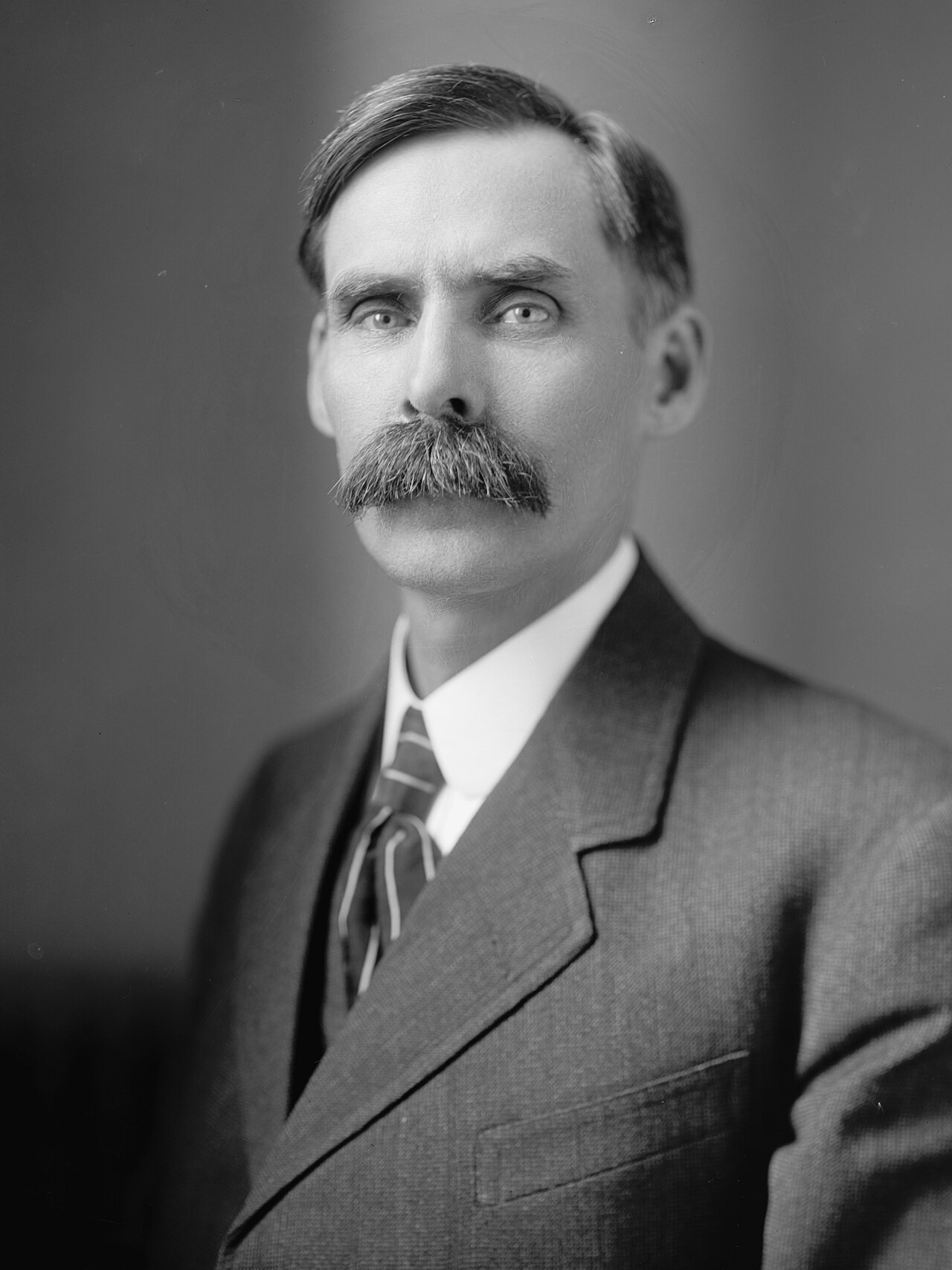
Kenyon roots
Volstead was born in Kenyon Township on October 31, 1860 (some sources give 1859), the son of Jon Einertson Vraalstad and Dorothea Mathea Lillo, who had come from Norway to the new farm country of Goodhue County. He grew up in the Norwegian Lutheran countryside the county historians describe, went to the parochial and public schools, and attended St. Olaf College in Northfield, then a decade old. He read law, was admitted to the bar in 1884, and practiced briefly in Grantsburg, Wisconsin before settling in 1886 in Granite Falls in western Minnesota, the town that would claim him for the rest of his life.
Granite Falls and Congress
In Granite Falls he was city attorney, Yellow Medicine County attorney (1887–1897), school board president and mayor (1900–1902). In 1902 he won Minnesota's Seventh District seat in the U.S. House as a Republican and held it for ten terms, from March 4, 1903 to March 3, 1923. A quiet, exacting lawyer rather than an orator, he became chairman of the House Judiciary Committee in 1919.
The Volstead Act
As Judiciary chairman he sponsored the National Prohibition Act of 1919, which defined "intoxicating liquor" as anything over one-half of one percent alcohol and set up the enforcement machinery for the Eighteenth Amendment. President Wilson vetoed it on October 27, 1919; the House overrode the veto the same day and the Senate the next. The bill had been conceived and largely drafted by Wayne Wheeler of the Anti-Saloon League, but it carried Volstead's name, and the name stuck to the whole era. He was not himself a crusading dry; he called the law a matter of enforcing the Constitution as amended. It cost him his seat in 1922, when he lost to Ole Kvale, a Lutheran minister running as an independent.
The other Volstead Act
His more durable legacy is the Capper-Volstead Act of 1922, which lets farmers form marketing cooperatives without violating the Sherman Antitrust Act. Every co-op elevator, creamery and farm-supply cooperative in the Upper Midwest, including the Central Farm Service and Ag Partners co-ops that still operate in Kenyon, exists under its protection. It has never been repealed.
Later life
After Congress he served as legal adviser to the Northwest Prohibition Enforcement District in St. Paul until repeal in 1933, then returned to private practice in Granite Falls. He died there on January 20, 1947, at 86, and is buried in Granite Falls Cemetery. His house at 163 Ninth Avenue in Granite Falls is a National Historic Landmark. Kenyon has no monument to him; the county history of 1909, written while he sat in Congress, lists the Vraalstad family among the township's Norwegian settlers.