Kenyon Cannot Outsource Its Way to Economic Growth
The city pays CEDA $55,053 a year for a part-time economic development coordinator and pays Abdo for finance, HR and payroll services its own staff report puts at $164,800 a year. Economic development should begin with the city's own spending decisions, and with the people who live here.
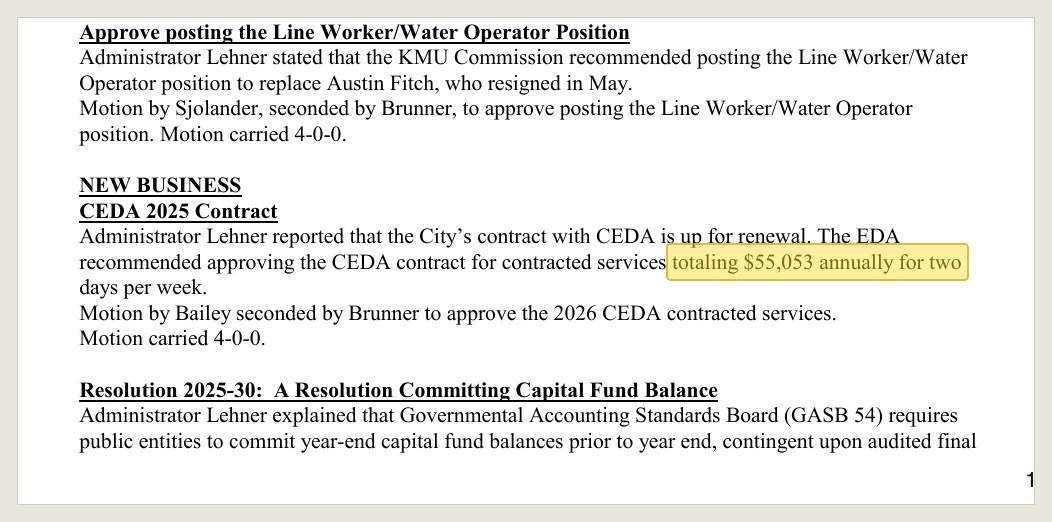
The absurdity of Kenyon’s current approach to economic development is that the city pays CEDA $55,053 annually for a part-time economic development coordinator, pays Abdo for finance, HR and payroll services that the city’s own staff report estimates at $164,800 annually, and employs a full-time city administrator to oversee both contracts, all while expecting Kenyon’s economy to grow. Abdo has been on contract since September 1, 2025, and the city paid it $66,086 in 2025 and $94,372 from January through August 2026.
Show up to the special council meeting
The council meets in special session tonight at 5:00 p.m. at City Hall, 709 Second Street. The agenda goes straight to economic development and to what Kenyon pays for:
- Business Park, electrical service, transformer, Compass. The industrial park is the city’s economic development project. The packet carries a cover sheet for this item and no staff report, no figures and no attachments.
- Grocery store tax abatement. A draft resolution would abate up to $40,000 of the city’s share of property taxes on Kenyon Market, 109 Red Wing Avenue, paid as $4,000 every six months from February 2027 to August 2031. The draft says “up to ten years” in one section and five years in the others. The public hearing is set for November 10 at 7:00 p.m.
- Council salaries. A draft ordinance under Minn. Stat. 415.11 would cut the mayor’s and every council member’s salary to $0 for twelve months.
- Fire Department appointments and a general discussion of past, future and pending projects, communication and a training session.
Every item is listed as a discussion. If you want to know what the business park, the abatement and the contracts are producing for Kenyon, tonight is the place to ask. Read the full packet.
Two Abdo representatives attend City Council meetings, yet in the recordings their visible participation often appears minimal. Residents can watch the publicly available meeting recordings on YouTube and judge for themselves. On July 14, 2026, when a council member asked for the breakdown of contracted services and a comparison of Abdo against an in-house finance director, the answer at the table was that it was “pretty much a wash,” with the ledger detail not pulled; the written comparison arrived eight weeks later. Why are two representatives needed at these meetings if the answers to direct questions arrive weeks afterward? The city should explain whether their meeting attendance is separately billed, what responsibilities require both representatives to be present, and what taxpayers receive in return.
What the CEDA contract has produced
Meanwhile, after years of paying CEDA for Todd Kieffer’s economic development services, Kenyon has little in the way of clearly documented, measurable economic growth to show for the expenditure. The publicly reported activities consist largely of meetings, surveys, grant applications, administrative coordination, and projects that have yet to produce substantial demonstrated results. Much of this work appears to overlap with responsibilities that existing City Council members, city staff, and local business owners could already undertake.
And here is the fundamental contradiction: Kenyon’s business owners help fund Kieffer’s $55,053 annual contract through their local taxes, even though they already have every financial incentive to attract customers, improve their properties, expand their operations, and grow the local economy themselves. Rather than using their tax dollars to pay an outside contractor to encourage business development, those owners could benefit from keeping more of their own money to reinvest directly into their businesses. That alternative deserves consideration rather than an assumption that every business owner prefers it. What specific economic value has Kieffer delivered that these existing stakeholders could not have generated themselves?
Invest in the people who live here
There may have been a time when small towns had little choice but to outsource professional work. But in 2026, technology has dramatically expanded what capable, locally employed people can accomplish. Kenyon should be examining the opportunity to invest directly in its own residents: hiring, training, trusting, and empowering people whose livelihoods are tied to the community’s future.
Money paid to outside contractors becomes revenue for organizations elsewhere; wages paid to local residents have the opportunity to circulate through Kenyon’s businesses, housing market, and local economy. Not every dollar stays local, and no investment guarantees a return, but the compounding potential is real. A handful of talented, accountable people empowered to solve problems, improve services, and build local economic activity could generate benefits far beyond their salaries. That is the kind of asymmetric upside investors seek: limited initial investment with the possibility of disproportionately large returns.
Instead, Kenyon continues committing substantial public resources to external organizations without demonstrating that those arrangements deliver greater value than local employment. A city cannot expect to build a thriving local economy while treating investment in its own people as an afterthought. Economic development should begin with the city’s own spending decisions.
The message it sends
And beyond the financial consequences, continually contracting with outsiders sends a troubling message: that Kenyon’s own residents cannot be trusted to do the work. This community is filled with intelligent, hardworking, capable people who would welcome the opportunity to earn the money currently being paid to outside firms, and who have a personal stake in seeing Kenyon succeed. These are people who live here, raise families here, support local businesses, and experience the consequences of every decision City Hall makes. They deserve to be considered, trusted, invested in, and empowered.
When a city repeatedly looks elsewhere for talent without first looking within, it risks telling its own people that their abilities, ambitions, and commitment aren’t enough. Kenyon doesn’t lack capable people. The question is whether its government is willing to give them the opportunity.
Sources
- Council minutes, December 9, 2025, CEDA 2026 contract, "totaling $55,053 annually for two days per week," 4-0-0; earlier terms in the minutes of November 12, 2024 ($53,580, one day a week to two).
- Council packet, September 8, 2026, "Abdo vs. Internal Finance Director," pp. 238 to 239: Abdo $164,800 ($109,000 finance, $30,000 HR, $25,800 payroll).
- City of Kenyon council recordings on YouTube, for example July 14, 2026 and August 6, 2026; every meeting is indexed on the meetings page.
- Abdo contract approved August 12, 2025, effective September 1, 2025; July 14, 2026 exchange at 1:25:31.
- Special City Council meeting, October 29, 2026, agenda and packet (16 pages).
- Payments to CEDA and Abdo from the city's check registers, contracts page.