Three days on the payroll, Lehner walked into a closed KMU meeting. They walked him out.
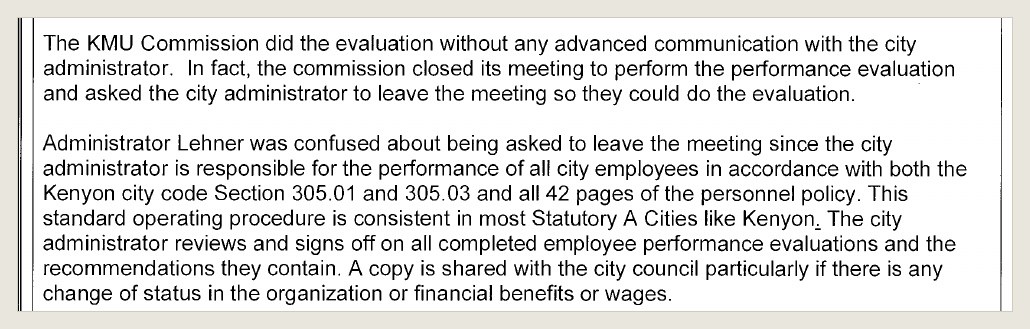
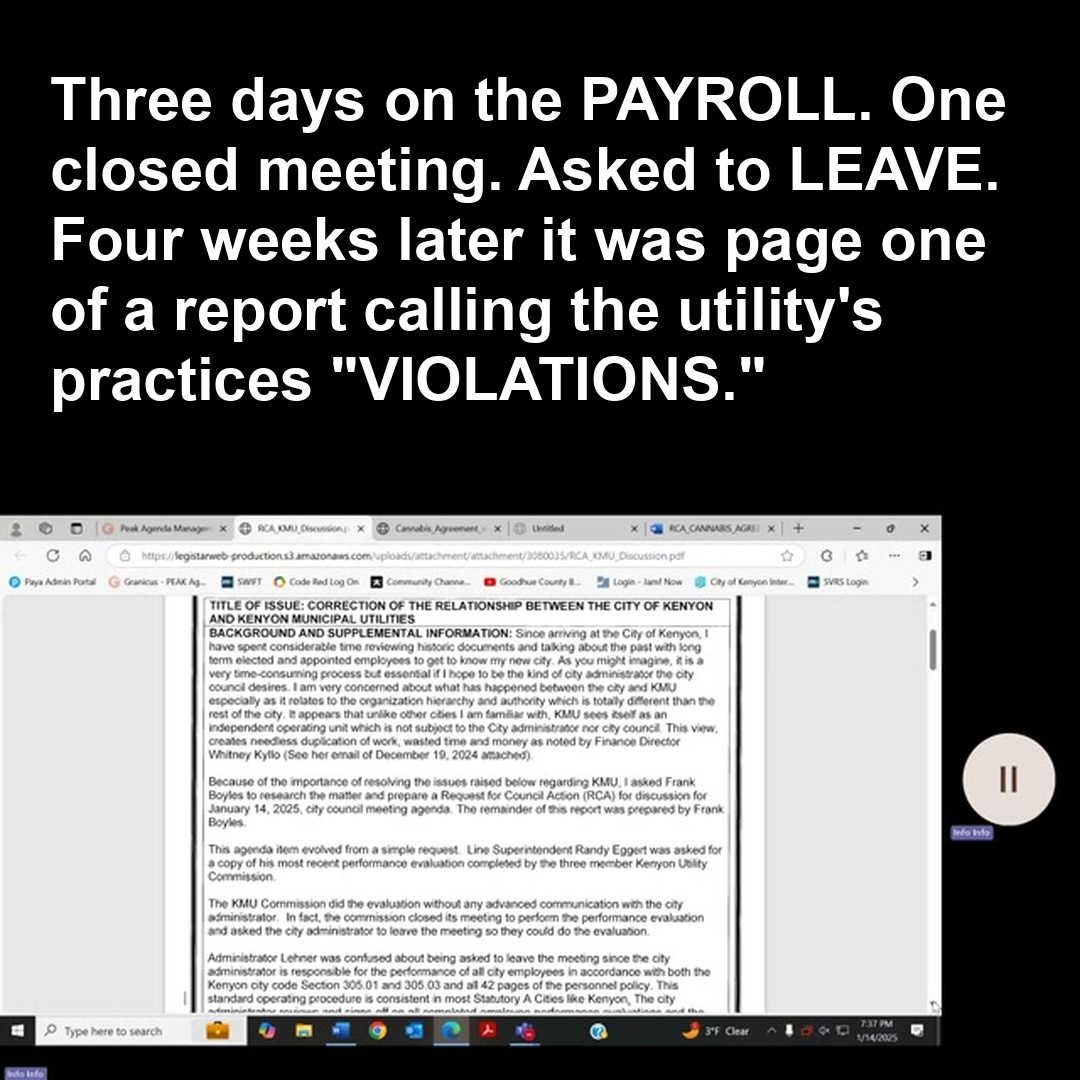
Scott Lehner went on Kenyon's payroll December 14, 2024. On December 17 he sat down in a Kenyon Municipal Utilities meeting, the commission closed the session to evaluate its superintendent, and he was asked to leave. Four weeks later that exit was the first grievance in a report calling the utility's practices "violations."
The first public fight of Scott Lehner's tenure as Kenyon city administrator was about a meeting he attended before he had a desk. The dates matter, because the people on the other side of the fight made them matter, and because the law on who could be in that room is not close.
Three dates in December
The council hired Lehner by Resolution 2024-26 on November 7, 2024. His payroll start, according to the finance director's answer on the recording, was December 14. He told the council he had it in his head that he started Monday, December 16, and that he "wasn't in the office" before then 1:13:53. On December 17 the Kenyon Municipal Utilities commission met at 4 p.m. Lehner drove down from the Twin Cities, arrived late, and sat in. The commission then closed the meeting to conduct the performance evaluation of its operations superintendent, Randy Eggert, and asked Lehner to leave.
That is where, in his own telling, it started. "It was demonstrated to me when I sat in in the meeting that I was asked to leave the meeting because they were going to close the meeting and they were going to do a performance evaluation. That's where it started for me. I'm like whoa, wait, what's going on here?" 1:01:28
What the law says about that room
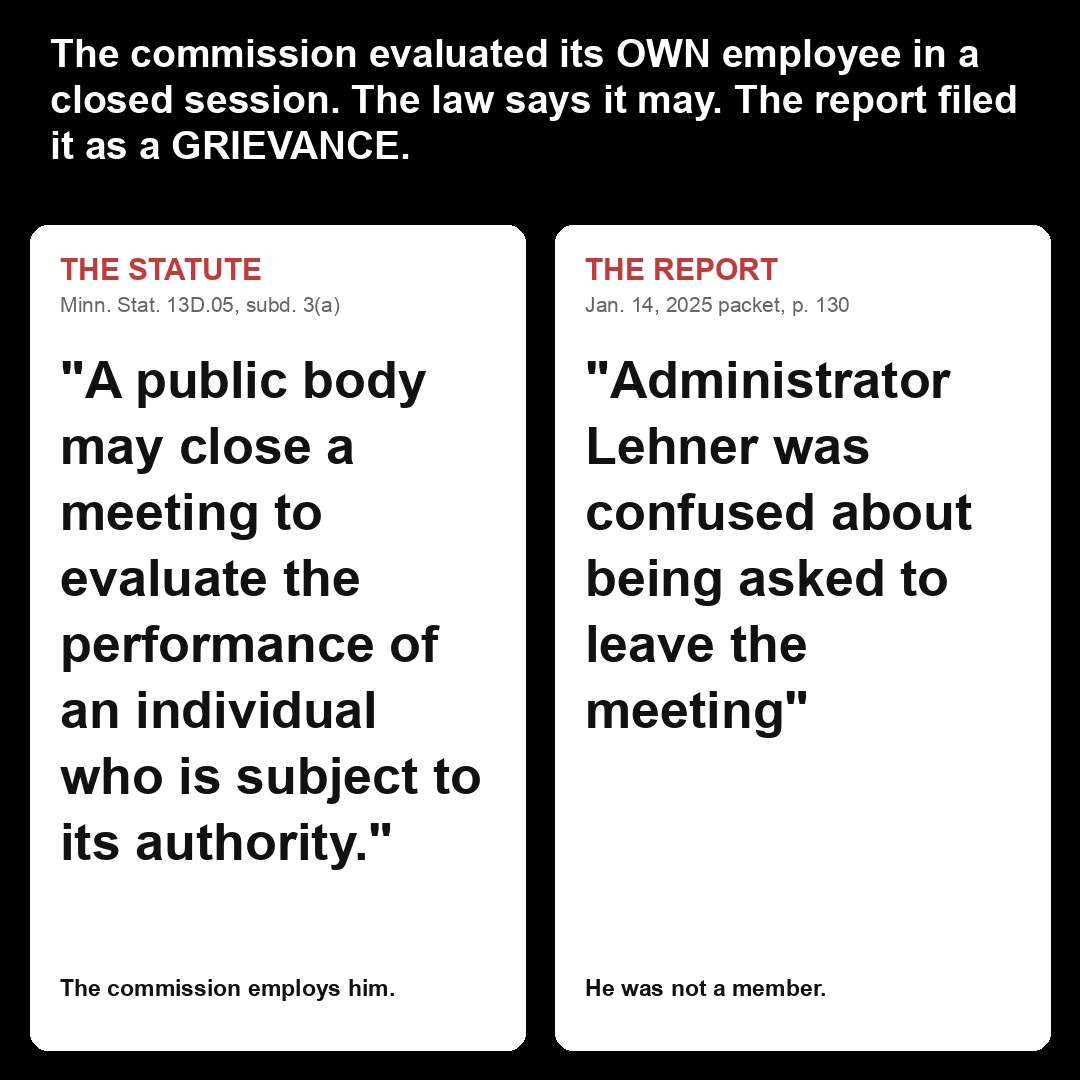
Minnesota Statute 13D.05, subdivision 3(a), lets a public body close a meeting "to evaluate the performance of an individual who is subject to its authority." Minnesota Statute 412.361, subdivision 2, gives a statutory city's public utilities commission the power "to employ all necessary help for the management and operation of the public utility, prescribe duties of officers and employees and fix their compensation." Eggert is the commission's employee. The commission may close a meeting to evaluate him, and nothing in either statute gives a city administrator, or anyone who is not a member, a seat inside a closed session. The commission did what the statute permits. The administrator was where the statute did not put him.
KMU only exists because the city's here. It was established in 1934 by ordinance under chapter 412. This is a statutory utility, an arm of the city, under Minnesota statutes chapter 412.City Attorney Scott Riggs, January 14, 2025, from the recording. 54:17
Riggs, who drafted the late-1990s agreements between the city and the utility, told the council the agreements put "everybody here in City Hall" under the city administrator and recommended getting "back to what these five agreements were." He also reminded the council that it appoints the three commissioners. None of that reaches the closed session. An agreement about shared staff does not repeal the statute that makes the commission the employer, and the statute is what governs who may be in the room when the employer evaluates its employee.
I officially started on the books. I wasn't in the office, but I started December 16th.Scott Lehner, Jan. 14, 2025, 1:13:53, from the city's caption track, source
The cross-examination
When the January 14 report came before the council, a speaker from the KMU side of the table asked Lehner directly when his start date was 1:13:15. The exchange that followed ran for four minutes. Lehner said the week of December 16. He said the KMU meeting was December 17, "before you started." Finance Director Whitney Kyllo said she had started his payroll on the 14th. Someone in the room said "well, it's even worse then." He asked how Lehner had learned of the meeting, whether by official agenda or "a private call." Lehner said he had started receiving calendar invitations to all city meetings after the council approved him in November and could not recall who sent that one. He said he had noticed "right away when you came into the meeting you were upset about not getting" something. Lehner said he did not recall being upset, only "a little kind of miffed" on the way out, "like what just happened here." Someone at the table asked whether this was "leading to a point," and the questioner said he was just curious 1:14:56.
Eggert then read a prepared statement. His title, he said, was operations superintendent, not line superintendent as the report had it. The evaluation had been done "as asked by me, with a request from me, to be done in a closed meeting." The evaluations of utility employees were kept in a locked file, with keys held by the superintendent, and he said City Attorney Riggs had told him he should be the one holding them 1:18:41.
Why three days matter
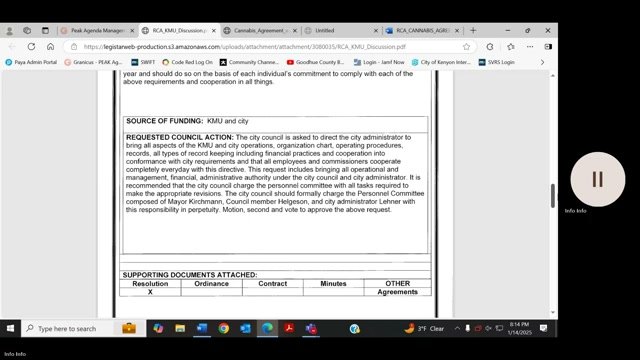
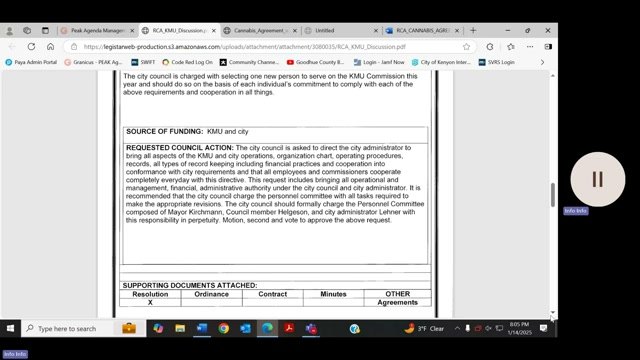
None of this would be worth a column if the December 17 exit had stayed a bruise. It became the first sentence of a formal request to the council. The January 14 packet describes the agenda item as having "evolved from a simple request" and states that the commission "asked the city administrator to leave the meeting so they could do the evaluation," and that "Administrator Lehner was confused about being asked to leave." The report then asks the council to bring "all operational and management, financial, administrative authority" over the utility under the council and the administrator. A closed evaluation the commission was entitled to hold, of an employee it was entitled to employ, attended by an administrator who by his own account was not yet in the office, became the stated origin of a demand that Minnesota law reserves to the voters.
Lehner had a real case about records and bank accounts, and the finance director made it for him later that night. He chose to open with the room he was walked out of. The questions about dates were not idle. They established that the grievance predated the job.
Before and after
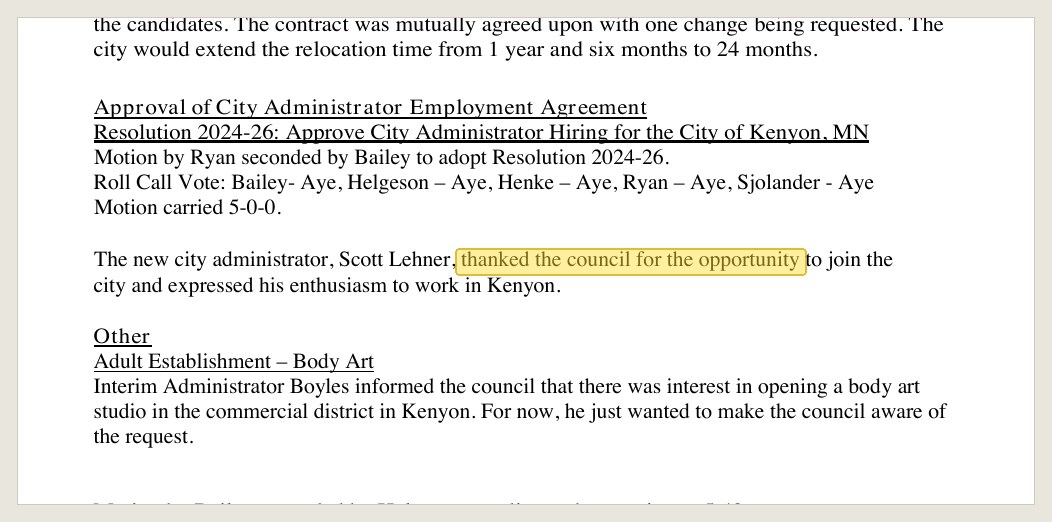
- Nov. 7, 2024The council adopts Resolution 2024-26 hiring Scott Lehner; he thanks the council for the opportunity to join the city.
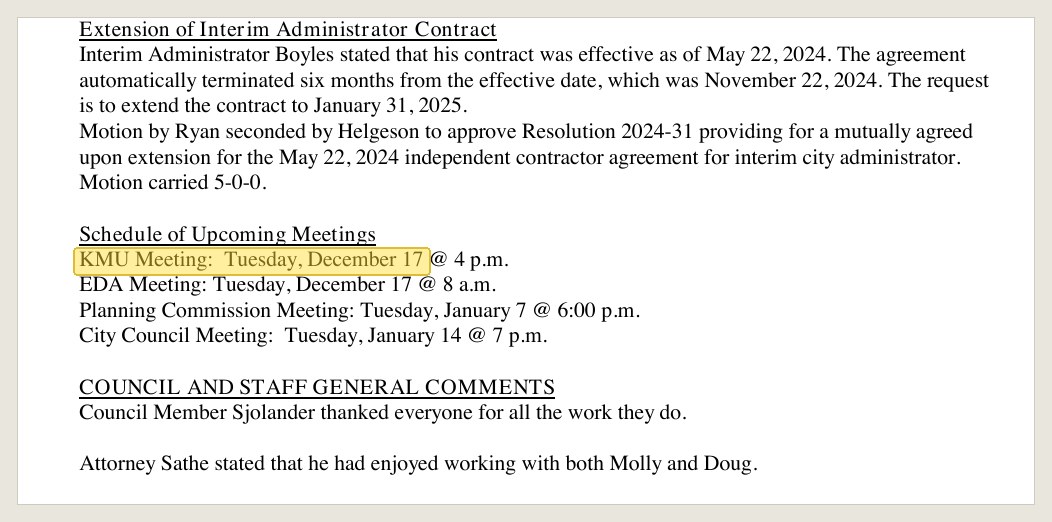
- Dec. 10, 2024The council's schedule of upcoming meetings lists "KMU Meeting: Tuesday, December 17 @ 4 p.m."
- Dec. 14, 2024Payroll start, according to Finance Director Whitney Kyllo.
- Dec. 16, 2024The Monday Lehner says he had in his head as his start; "I wasn't in the office" before then.
- Dec. 17, 2024He arrives late to the KMU meeting; the commission closes it to evaluate Randy Eggert and asks him to leave.
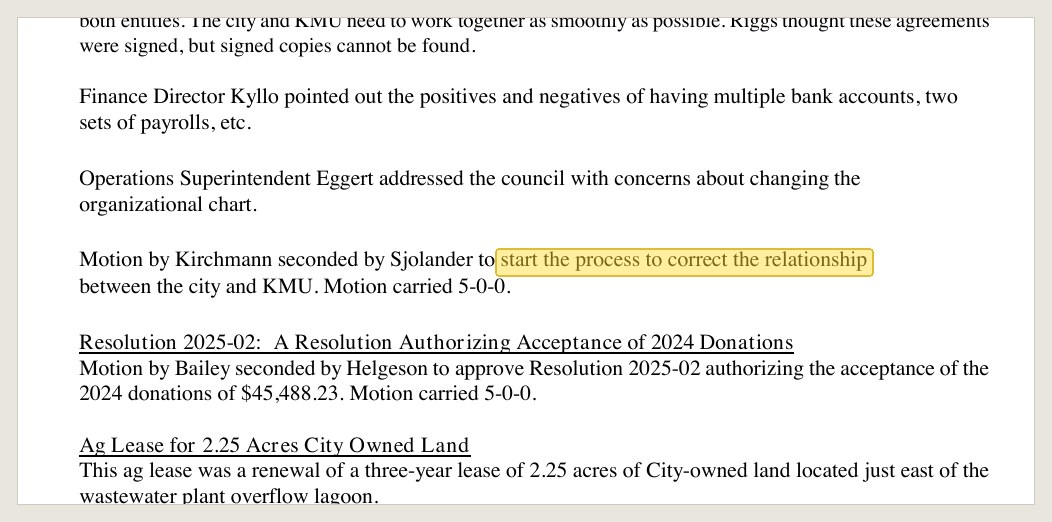
- Jan. 14, 2025The exit appears on page 130 of the packet as the origin of the request; the council votes 5-0-0 "to start the process to correct the relationship between the city and KMU."
What the statute says
A public body may close a meeting to evaluate the performance of an individual who is subject to its authority.
The commission employs the superintendent, so it may close a meeting to evaluate him. Nothing gives a non-member a seat inside.
The commission shall have power to employ all necessary help for the management and operation of the public utility, prescribe duties of officers and employees and fix their compensation.
By statute the utilities commission, not the city administrator, is the employer of KMU staff.
People in this story
- Scott LehnerCity administrator, on the payroll since December 14, 2024
- Randy EggertOperations superintendent, Kenyon Municipal Utilities
- Whitney KylloFinance director; said on the recording she started his payroll on the 14th
- Scott RiggsCity attorney, Kennedy & Graven
- Don KirchmannMayor since January 2025; KMU commissioner
Sources
- City of Kenyon recording, January 14, 2025, at 54:17, 1:01:28, 1:13:15 to 1:16:59, and 1:18:41.
- Packet, January 14, 2025, Request for Council Action, pp. 130 to 132.
- Minutes, November 7, 2024, Resolution 2024-26.
- Minnesota Statutes 13D.05 and 412.361.
More from the record
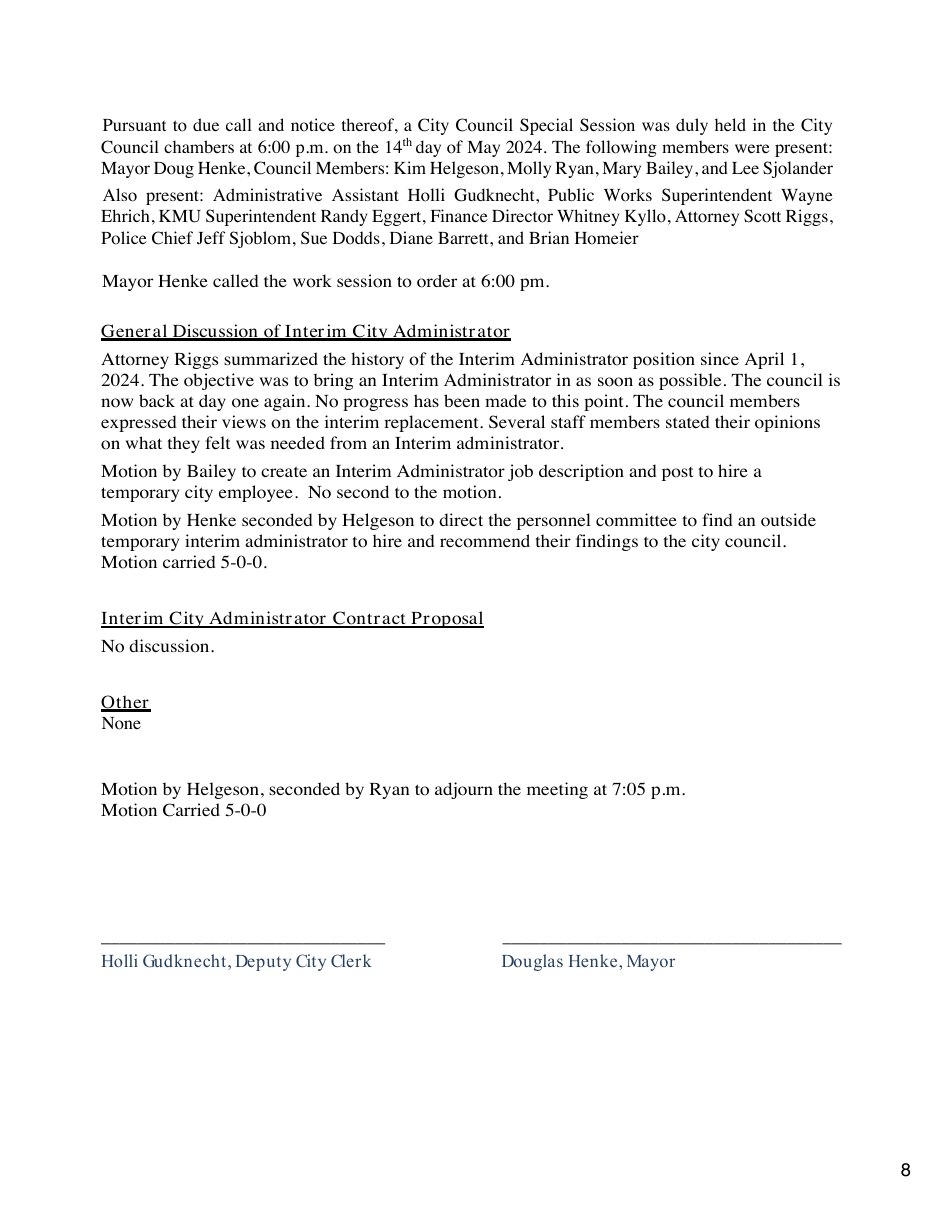
Kenyon could have hired its own interim administrator for the price of a job description. Nobody seconded.
Week four: Lehner asks the council to hand him a utility that only a referendum can hand over.
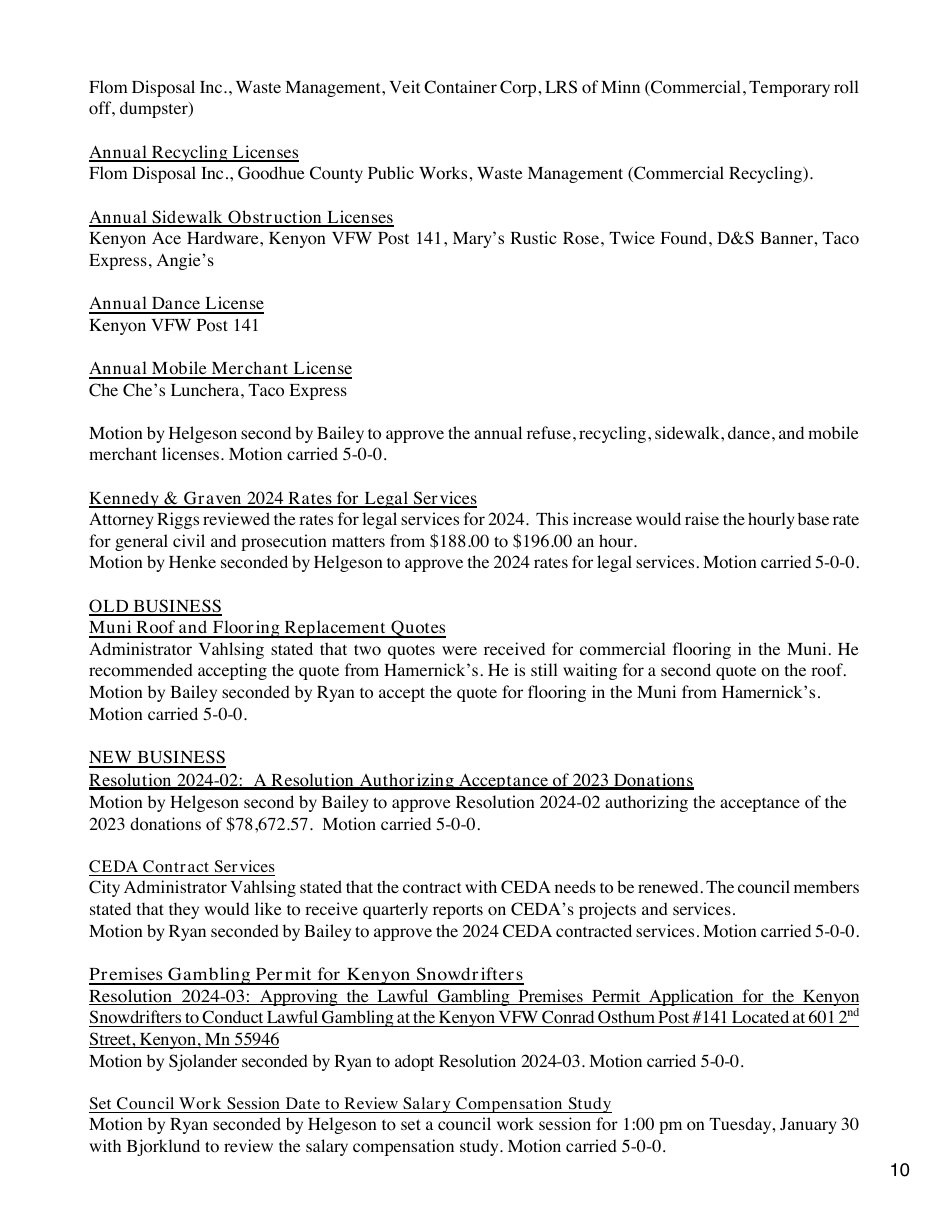
The council told CEDA to report every quarter. CEDA has skipped eleven quarters and kept the contract.
All 27, in order · The open letter · Every packet and recording